Friday, October 13, 2006
I know Someone Related To A Saint
There is a girl in one of my classes who is the great (there might be another great in there?) grand-niece of Rafael Guizar Valencia who will be canonized on Sunday by Pope Benedict. Ask for his intercession. Tell him I sent you. (as if I had any sway just because I am in the same class as his great grand-niece!)

Newman: The Great Orator
I am currently doing research for a paper about John Henry Newman and the teachings found in his sermons and I came across Newman's 7 rules for writing a sermon. Newman was a great orator (and Oratorian)who, through his writings and sermons, converted thousands of people.
All you priests out there pay attention!
1) A man should be earnest, by which I mean he should write not for the sake of writing, but to bring out his thoughts.
2) He should never aim at being eloquent.
3) He should keep his idea in view, and should write sentences over and over again until he has expressed his meaning accurately, forcibly, and in a few words.
4) He should aim at being understood by his hearers or readers.
5) He should use words which are likely to be understood. Ornament and amplification will come spontaneously in due time, but he should never seek them.
6) He must creep before he can fly, by which I mean that humility which is a great Christian virtue has a place in literary composition.
7) He who is ambitious will never write well, but he who tries to say simply what he feels, what religion demands, what faith teaches, what the Gospel promises, will be eloquent without intending it, and will write better English than if he made a study of English Literature.
Okay, now get to writing those marvelous sermons and start converting souls! And remember, of all forms of Christian instruction, the liturgical homily is to hold pride of place (Dei Verbum 24).
All you priests out there pay attention!
1) A man should be earnest, by which I mean he should write not for the sake of writing, but to bring out his thoughts.
2) He should never aim at being eloquent.
3) He should keep his idea in view, and should write sentences over and over again until he has expressed his meaning accurately, forcibly, and in a few words.
4) He should aim at being understood by his hearers or readers.
5) He should use words which are likely to be understood. Ornament and amplification will come spontaneously in due time, but he should never seek them.
6) He must creep before he can fly, by which I mean that humility which is a great Christian virtue has a place in literary composition.
7) He who is ambitious will never write well, but he who tries to say simply what he feels, what religion demands, what faith teaches, what the Gospel promises, will be eloquent without intending it, and will write better English than if he made a study of English Literature.
Okay, now get to writing those marvelous sermons and start converting souls! And remember, of all forms of Christian instruction, the liturgical homily is to hold pride of place (Dei Verbum 24).
Wednesday, October 11, 2006
Latin Mass Enthusiasts Can Now Rejoice
"Pope Benedict XVI is preparing to release a motu proprio extending permission for priests to celebrate the traditional Latin Mass, Vatican sources have confirmed.
The new papal document-- for which a publication date has not yet been set-- would give all priests permission to celebrate the Mass of St. Pius V. This permission, a "universal indult," would replace the existing indult that dates back to 1988, when Ecclesia Dei authorized use of the Tridentine rite until more restricted conditions, requiring the permission of the local bishop." [source]
The new papal document-- for which a publication date has not yet been set-- would give all priests permission to celebrate the Mass of St. Pius V. This permission, a "universal indult," would replace the existing indult that dates back to 1988, when Ecclesia Dei authorized use of the Tridentine rite until more restricted conditions, requiring the permission of the local bishop." [source]
The Lord's Prayer
“We need to use words so that we may remind ourselves to consider carefully what we are asking, not so that we may think we can instruct the Lord or prevail on him.
Thus when we say: Hallowed be your name, we are reminding ourselves to desire that his name, which in fact is always holy, should also be considered holy among men. I mean that it should not be held in contempt. But this is a help for men, not for God.
And as for our saying: Your kingdom come, it will surely come whether we will it or not. But we are stirring up our desires for the kingdom so that it can come to us and we can deserve to reign there.
When we say: Your will be done on earth as it is in heaven, we are asking him to make us obedient so that his will may be done in us as it is done in heaven by his angels.
When we say: Give us this day our daily bread: in saying this day we mean “in this world.” Here we ask for a sufficiency by specifying the most important part of it; that is, we use the word “bread” to stand for everything. Or else we are asking for the sacrament of the faithful, which is necessary in this world, not to gain temporal happiness but to gain the happiness that is everlasting.
When we say: Forgive us our trespasses as we forgive those who trespass against us, we are reminding ourselves of what we myst ask and what we must do in order to be worthy in turn to receive.
When we say: Lead us not into temptation, we are reminding ourselves to ask that his help may not depart from us; otherwise we could be seduced and consent to some temptation, or despair and yield to it.
When we say: Deliver us from evil, we are reminding ourselves to reflect on the fact that we do not yet enjoy the state of blessedness in which we shall suffer no evil. This is the final petition contained in the Lord’s Prayer, and it has a wide application. In this petition the Christian can utter his cries of sorrow, in it he can shed his tears, and through it he can begin, continue and conclude his prayer, whatever the distress in which he finds himself. Yes, it was very appropriate that all these truths should be entrusted to us to remember in these very words.
Whatever be the other words we may prefer to say (words which the one praying chooses so that his disposition may become clearer to himself or which he simply adopts so that his disposition may be intensified), we say nothing that is not contained in the Lord’s Prayer, provided of course we are praying in a correct and proper way. But if anyone says something which is incompatible with this prayer of the Gospel, he is praying in the flesh, even if he is not praying sinfully. And yet I do not know how this could be termed anything but sinful, since those who are born again through the Spirit ought to pray only in the Spirit."
-St. Augustine
Thus when we say: Hallowed be your name, we are reminding ourselves to desire that his name, which in fact is always holy, should also be considered holy among men. I mean that it should not be held in contempt. But this is a help for men, not for God.
And as for our saying: Your kingdom come, it will surely come whether we will it or not. But we are stirring up our desires for the kingdom so that it can come to us and we can deserve to reign there.
When we say: Your will be done on earth as it is in heaven, we are asking him to make us obedient so that his will may be done in us as it is done in heaven by his angels.
When we say: Give us this day our daily bread: in saying this day we mean “in this world.” Here we ask for a sufficiency by specifying the most important part of it; that is, we use the word “bread” to stand for everything. Or else we are asking for the sacrament of the faithful, which is necessary in this world, not to gain temporal happiness but to gain the happiness that is everlasting.
When we say: Forgive us our trespasses as we forgive those who trespass against us, we are reminding ourselves of what we myst ask and what we must do in order to be worthy in turn to receive.
When we say: Lead us not into temptation, we are reminding ourselves to ask that his help may not depart from us; otherwise we could be seduced and consent to some temptation, or despair and yield to it.
When we say: Deliver us from evil, we are reminding ourselves to reflect on the fact that we do not yet enjoy the state of blessedness in which we shall suffer no evil. This is the final petition contained in the Lord’s Prayer, and it has a wide application. In this petition the Christian can utter his cries of sorrow, in it he can shed his tears, and through it he can begin, continue and conclude his prayer, whatever the distress in which he finds himself. Yes, it was very appropriate that all these truths should be entrusted to us to remember in these very words.
Whatever be the other words we may prefer to say (words which the one praying chooses so that his disposition may become clearer to himself or which he simply adopts so that his disposition may be intensified), we say nothing that is not contained in the Lord’s Prayer, provided of course we are praying in a correct and proper way. But if anyone says something which is incompatible with this prayer of the Gospel, he is praying in the flesh, even if he is not praying sinfully. And yet I do not know how this could be termed anything but sinful, since those who are born again through the Spirit ought to pray only in the Spirit."
-St. Augustine
Monday, October 09, 2006
The New Adam And The New Eve
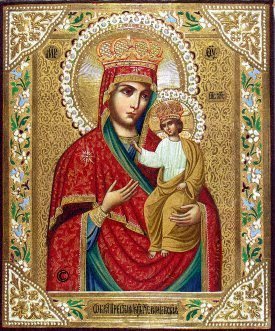
"Even in Heaven Mary exercises the office of being our Advocate, that office which Jesus entrusted to her on Calvary; this is so that the Redemption might completely repair the fall, even in superabundance. To Adam and Eve, sinners and the source of original sin in this world, God has countered with Christ and Mary, the Redeemer and Co-redemptrix of the human race."
-Blessed Ildephonse Cardinal Schuster
Synergism
“If we accept that the human being has been created by God, endowed with freedom, and made responsible for his or her own life, and even if we accept in addition that there are limits to freedom and responsibility, and especially that through the weakness of sin no human being can attain wholeness of life through effort that is unaided by divine grace-- even Kant in spite of his insistence on autonomy conceded as much-- yet we are still bound to say that there must be some human contribution to the work of redemption, even if it is no more than responsive and never of equal weight with the grace of God.
While the champions of sola gratia have concentrated their attention on some passages of scripture and have probably interpreted even these in a one-sided way, there are other passages, even in the writings of Paul, where the element of cooperation in the work of salvation seems to be clearly recognized. It is Paul who, after the magnificent hymn in praise of Christ’s redeeming work, in his letter to the Philippians, goes on immediately to say to the Christian believers: “Work out your own salvation with fear and trembling; for God is at work in you” (Phil. 2:12). The thought here seems clearly to be that God’s work and man’s work go on side by side in the realization of salvation. In another epistle, he writes: “Working together with him, then, we entreat you not to accept the grace of God in vain” (2 Cor. 6:1). A straightforward interpretation of these words seem quite incompatible with any rigorous doctrine of sola gratia. For what does it mean “to accept the grace of God in vain” but to fail to make any response to this grace, to refrain from any answering work? The expression “working together with him,” which has also been translated “as co-workers with him,” is in Greek synergountes, from which we derive the English word “synergism,” cited at an earlier stage in the discussion. This word “synergism” is the usual theological term for the point of view I have been commending, namely, that human salvation is accomplished neither by man’s own unaided efforts nor by an act of God entirely outside of man, but by a synergism or co-working, in which, of course, the initiative and weight lie on the side of God, but the human contribution is also necessary and cannot be left out of the account.
Before we leave the New Testament on these questions, let us call to mind in addition to the Pauline material the letter of James. Luther was so unhappy with this letter that he questioned whether it should ever have been included in the canon of the New Testament. It seem inconsistent with Paul’s insistence that we are justified by faith, not by works, or perhaps we should say, with Paul’s view of these matters as interpreted by Luther. But one could say that the apparent tension between James and Paul should not be taken to mean that James should have been excluded from the canon, but rather that the inclusion of his letter is a much needed corrective to some of the more one-sided Pauline pronouncements as they have been commonly understood. “What does it profit, my brethren,” asks James, “if a man says he has faith but has not works? Can his faith save him? If a brother or sister is ill-clad and in lack of daily food, and one of you say to them, ‘Go in peace, be warmed and filled,’ without giving them the things needed for the body, what does it profit? So faith, by itself, if it has no works, is dead” (Jas. 2:14-17). Or perhaps one should say that faith, as decision, is itself the beginning of the work.
Luther’s friend and associate, Philip Melanchthon, was the principal theologian of the Lutheran Reformation. It is often claimed that he taught a doctrine of synergism, though some Lutherans have tried to play down this side of his teaching. But others have accused him of betraying the Lutheran cause and of subverting even the key doctrine of justification by grace alone. The truth is that Melanchthon retained a strong humanistic bias through the passionate controversial years following the Reformation, and therefore he could never feel at ease with doctrines which seemed to him to threaten such essential human characteristics as rationality, freedom, and responsibility. So he was obviously unhappy with such notions as predestination and irresistible grace. He could not accpet that, as he put it, “God snatches you by some violent rapture, so that you must believe, whether you will or not.” Again, he protested that the Holy Spirit does not work on a human being as on a statue, a piece of wood or a stone. The human will has its part to play in redemption, as well as the Word of God and the Spirit of God. Such teaching might seem to us to be common sense, but in the highly charged atmosphere of Melanchthon’s time, it needed courage to say such things, and it brought angry rejoinders from other Lutherans. But Melanchthon shows that even at the heart of Lutheran theology an effort was being made to find an acceptable place for synergism or co-working between God and man in the work of salvation.”
-Dr. John Macquarrie, Anglican Philosopher and Theologian.
While the champions of sola gratia have concentrated their attention on some passages of scripture and have probably interpreted even these in a one-sided way, there are other passages, even in the writings of Paul, where the element of cooperation in the work of salvation seems to be clearly recognized. It is Paul who, after the magnificent hymn in praise of Christ’s redeeming work, in his letter to the Philippians, goes on immediately to say to the Christian believers: “Work out your own salvation with fear and trembling; for God is at work in you” (Phil. 2:12). The thought here seems clearly to be that God’s work and man’s work go on side by side in the realization of salvation. In another epistle, he writes: “Working together with him, then, we entreat you not to accept the grace of God in vain” (2 Cor. 6:1). A straightforward interpretation of these words seem quite incompatible with any rigorous doctrine of sola gratia. For what does it mean “to accept the grace of God in vain” but to fail to make any response to this grace, to refrain from any answering work? The expression “working together with him,” which has also been translated “as co-workers with him,” is in Greek synergountes, from which we derive the English word “synergism,” cited at an earlier stage in the discussion. This word “synergism” is the usual theological term for the point of view I have been commending, namely, that human salvation is accomplished neither by man’s own unaided efforts nor by an act of God entirely outside of man, but by a synergism or co-working, in which, of course, the initiative and weight lie on the side of God, but the human contribution is also necessary and cannot be left out of the account.
Before we leave the New Testament on these questions, let us call to mind in addition to the Pauline material the letter of James. Luther was so unhappy with this letter that he questioned whether it should ever have been included in the canon of the New Testament. It seem inconsistent with Paul’s insistence that we are justified by faith, not by works, or perhaps we should say, with Paul’s view of these matters as interpreted by Luther. But one could say that the apparent tension between James and Paul should not be taken to mean that James should have been excluded from the canon, but rather that the inclusion of his letter is a much needed corrective to some of the more one-sided Pauline pronouncements as they have been commonly understood. “What does it profit, my brethren,” asks James, “if a man says he has faith but has not works? Can his faith save him? If a brother or sister is ill-clad and in lack of daily food, and one of you say to them, ‘Go in peace, be warmed and filled,’ without giving them the things needed for the body, what does it profit? So faith, by itself, if it has no works, is dead” (Jas. 2:14-17). Or perhaps one should say that faith, as decision, is itself the beginning of the work.
Luther’s friend and associate, Philip Melanchthon, was the principal theologian of the Lutheran Reformation. It is often claimed that he taught a doctrine of synergism, though some Lutherans have tried to play down this side of his teaching. But others have accused him of betraying the Lutheran cause and of subverting even the key doctrine of justification by grace alone. The truth is that Melanchthon retained a strong humanistic bias through the passionate controversial years following the Reformation, and therefore he could never feel at ease with doctrines which seemed to him to threaten such essential human characteristics as rationality, freedom, and responsibility. So he was obviously unhappy with such notions as predestination and irresistible grace. He could not accpet that, as he put it, “God snatches you by some violent rapture, so that you must believe, whether you will or not.” Again, he protested that the Holy Spirit does not work on a human being as on a statue, a piece of wood or a stone. The human will has its part to play in redemption, as well as the Word of God and the Spirit of God. Such teaching might seem to us to be common sense, but in the highly charged atmosphere of Melanchthon’s time, it needed courage to say such things, and it brought angry rejoinders from other Lutherans. But Melanchthon shows that even at the heart of Lutheran theology an effort was being made to find an acceptable place for synergism or co-working between God and man in the work of salvation.”
-Dr. John Macquarrie, Anglican Philosopher and Theologian.
Sunday, October 08, 2006
O Sweet Sacrament
"Since it was the will of God’s only-begotten Son that men should share in his divinity, he assumed our nature in order that by becoming man he might make men gods. Moreover, when he took our flesh he dedicated the whole of its substance to our salvation. He offered his body to God the Father on the altar of the cross as a sacrifice for our reconciliation. He shed his blood for our ransom and purification, so that we might be redeemed from our wretched state of bondage and cleansed from all sin. But to ensure that the memory of so great a gift would abide with us for ever, he left his body as food and his blood as drink for the faithful to consume in the form of bread and wine.
O precious and wonderful banquet, that brings us salvation and contains all sweetness! Could anything be of more intrinsic value? Under the old law it was the flesh of calves and goats that was offered, but here Christ himself, the true God, is set before us as our food. What could be more wonderful than this? No other sacrament has greater healing power; through it sins are purged away, virtues are increased, and the soul is enriched with an abundance of every spiritual gift. It is offered in the Church for the living and the dead, so that what was instituted for the salvation of all may be for the benefit of all. Yet, in the end, no one can fully express the sweetness of this sacrament, in which spiritual delight is tasted at its very source, and in which we renew the memory of that surpassing love for us which Christ revealed in his passion.
It was to impress the vastness of this love more firmly upon the hearts of the faithful that our Lord instituted this sacrament at the Last Supper. As he was on the point of leaving the world to go to the Father, after celebrating the Passover with his disciples, he left it as a perpetual memorial of his passion. It was the fulfillment of ancient figures and the greatest of his miracles, while for those who were to experience the sorrow of his departure, it was destined to be a unique and abiding consolation."
-St. Thomas Aquinas
O precious and wonderful banquet, that brings us salvation and contains all sweetness! Could anything be of more intrinsic value? Under the old law it was the flesh of calves and goats that was offered, but here Christ himself, the true God, is set before us as our food. What could be more wonderful than this? No other sacrament has greater healing power; through it sins are purged away, virtues are increased, and the soul is enriched with an abundance of every spiritual gift. It is offered in the Church for the living and the dead, so that what was instituted for the salvation of all may be for the benefit of all. Yet, in the end, no one can fully express the sweetness of this sacrament, in which spiritual delight is tasted at its very source, and in which we renew the memory of that surpassing love for us which Christ revealed in his passion.
It was to impress the vastness of this love more firmly upon the hearts of the faithful that our Lord instituted this sacrament at the Last Supper. As he was on the point of leaving the world to go to the Father, after celebrating the Passover with his disciples, he left it as a perpetual memorial of his passion. It was the fulfillment of ancient figures and the greatest of his miracles, while for those who were to experience the sorrow of his departure, it was destined to be a unique and abiding consolation."
-St. Thomas Aquinas
Friday, October 06, 2006
Dr. Miravalle's Response To 7 Common Objections To Mary As Co-Redemptrix: Objection 7
Objection 7: While granting the legitimacy of Mary Co-redemptrix and its corresponding doctrine of co-redemption, there are no substantial reasons or fruits for its papal definition at this time, and in fact such a definition would cause serious division within the Church.
Response:
It must be stated from the outset that such a position regarding a potential papal definition of Mary Co-redemptrix is certainly an acceptable position by a faithful member of the Catholic Church. Notwithstanding, let us explore, in a brief summary format, some of the numerous contemporary reasons presently being offered in support of the appropriateness and consequent positive fruits of a formal papal definition of Mary Co-redemptrix.
1. Greater theological clarity to an area of present misunderstanding
When Bl. Pius IX raised the Church doctrine of the Immaculate Conception to the level of dogma in 1854, he stated that the fruits of such definition would be to "bring to perfection" the doctrine, adding greater clarity and light for the benefit of all:
The Church labors hard to polish the previous teachings, to bring to perfection their formulation in such a way that these older dogmas of the heavenly doctrine receive proof, light, distinction, while keeping their fullness, their integrity, their own character...
In light of the substantial contemporary confusion concerning precisely what the Catholic Church means to convey in the doctrine of Marian co-redemption (as evidenced by the recent The New York Times piece and its reaction), it would seem most beneficial to have a precise statement, scripturally formulated in light of Christian Tradition, from the highest authority of the Catholic Church, ensuring its doctrinal precision and authenticity.
2. Ecumenical benefits in an authentic Catholic expression of doctrinal dialogue
Rather than its perception as being against the imperative of working for Christian unity, a precise formulation of what Catholics believe regarding Mary Co-redemptrix, and at the same time what they do not believe (i.e., equality with Jesus Christ, divinity of Mary, etc.) will only serve authentic ecumenical dialogue based on integrity and truth as to what is already a Catholic doctrinal teaching.
The late Cardinal John O'Connor of New York referred to this potential ecumenical fruit in his letter of endorsement for the papal definition of Mary Co-redemptrix:
Clearly, a formal papal definition would be articulated in such precise terminology that other Christians would lose their anxiety that we do not distinguish adequately between Mary's unique association with Christ and the redemptive power exercised by Christ alone.
Such a definition would help avoid the dangerous tendency to present in ecumenical dialogue only those doctrinal elements Christians share together, rather than the difficult but necessary aspect of sharing those doctrinal elements Christians do not hold in common. Such integrity in ecumenical doctrinal exchange is critically necessary in eventually arriving at any true Christian unity.
3. Proper development of Marian doctrine
The existing four Marian Dogmas, the Motherhood of God (431), the Perpetual Virginity (649), the Immaculate Conception (1854), and the Assumption (1950), all deal with the attributes or qualities of Mary's earthly life, but none directly refer to the Mother of Jesus in relation to the human family.
It is interesting to note historically that only one month following the papal definition of Mary's Assumption in November 1950, the International Mariological Congress formally petitioned Pope Pius XII for the papal definition of Mary's universal mediation as a logical progression following the definition of the Assumption.
After the early life and attributes of Mary have received their respective "perfections of doctrine" in solemn dogmatic definitions, so too it would seem appropriate that Mary's heavenly prerogative as spiritual mother of all peoples in the order of grace, inclusive of and founded upon her unique co-redemption, would also receive its doctrinal perfecting in the form of a dogmatic definition.
4. Affirmation of the dignity of the human person and human freedom
One of the world's leading contemporary personalist philosophers (from the philosophical school focusing upon the dignity of the human person), Professor Dr. Josef Seifert, argues that a dogma of Mary Co-redemptrix would constitute a supreme confirmation of the dignity and freedom the human person:
A dogma that declares Mary Co-redemptrix would give unique witness to the full freedom of the human person and to God's respect for human freedom. This dogma would recognize in an ultimate way that a free decision of the human person of Mary, who was not even to become the Mother of God without her free fiat—a decision which was not exclusively caused by divine grace but was also the fruit of her own personal choice—was necessary for our salvation, or played an indispensable part in the concrete way of our redemption chosen by God.
In our age, in which a personalist philosophy was developed more deeply than ever before in the history of mankind, and in which at the same time terrible anti-personalist ideologies reign, such a dogma would rightfully be perceived as a supreme confirmation of the dignity of the human person.
In all of this I would see a crucial value and significance of this dogma being proclaimed in our time in which both a new awareness of personal dignity arose and in which the person has been more humiliated in action and denied in theory than ever before.
5. Re-affirmation of the dignity of woman
In the contemporary discussion of feminism and the nature of woman, the papal proclamation of Mary Co-redemptrix would underscore what could properly identified as God's radical love and respect for woman. According to Christian Scripture, the entire providential plan of God the Father to send his Son for the redemption of the world was contingent upon the free fiat of a woman (Cf. Lk 1:38; Gal 4:4). What "trust' God the Father has in woman in the person of Mary that He would make the coming of the Redeemer of the entire human family conditional upon this woman's free consent.
As Dr. Seifert again points out:
This new declaration of the Traditional doctrine would therefore show anew a perpetual truth about Mary and about woman, a truth which was always held by the Church but never clearly and indubitably stated: the greatest deed of God's gracious love—the Redemption of mankind and our salvation—is in some real sense also the consequence of a free act of a woman and thus also the gift of a woman to humanity.
And further:
This dogma would express the dignity of a woman's action which exceeds in activeness, sublimity and effectiveness the deeds of all pure creatures and men: of all kings and politicians, thinkers, scientists, philosophers, artists and craftsmen from the beginning of the world to the end....
The fully defined revelation and role of Mary Co-redemptrix could thereby be offered as an exemplary foundation for better understanding the unique contribution of feminism to humanity and, as such, constitute a foundational anthropological basis for authentic Christian feminism.
6. Re-emphasis of the Christian need to cooperate with God's grace for salvation
Anglican Oxford scholar, Dr. John Macquarrie, states that the role of Mary Co-redemptrix provides a concrete expression of the human necessity to freely and actively cooperate with God's grace for salvation. He moreover sees the Christian truth of Mary Co-redemptrix as a corrective for theologies that remove such dignity to the person, and in consequence, put forth an undesirable image of Christianity itself. As synthesized by Dr. Macquarrie in this extended citation:
In some forms of teaching, it is even believed that human beings can be saved without even knowing that salvation is taking place. It has all taken place already through the once-for-all redeeming work of Christ. It is a fact, whether anyone recognizes it or not...For Barth, the (subjective) Redemption is a purely objective act, already finished 'outside of us, without us, even against us...Redemption is not, in his view, to be considered as an ongoing process in which we have some part, but as the once-for-all act of God long before we were born...
Now if one conceded Barth's point, then I think one would have to say that he is indeed treating human beings like sheep or cattle or even marionettes, not as unique beings that they are, spiritual beings made in the image of God and entrusted with a measure of freedom and responsibility...It is understandable that that Feuerbach, Marx, Nietzsche and a whole galaxy of modern thinkers came to believe that Christianity alienates them from a genuine humanity...
Let us now come back to the consideration of Mary as Co-redemptrix. Perhaps we do have to acknowledge that Barth and others have been correct in believing that the place given to Mary in catholic theology is a threat to the doctrine of sola gratia (grace alone), but I think this is the case only when the doctrine of sola gratia is interpreted in its extreme form, when this doctrine itself becomes a threat to a genuinely personal and biblical view of the human being...a being still capable of responding to God in the work of building up creation. This hopeful view of the human race is personified and enshrined in Mary.
In the glimpses of Mary that we have in the gospels, her standing at the cross beside her Son, and her prayers and intercessions with the apostles, are particularly striking ways in which Mary shared and supported the work of Christ...it is Mary who has come to symbolize the perfect harmony between the divine will and the human response, so that it is she who gives meaning to the expression Co-redemptrix.
Mary Co-redemptrix and its new proclamation would serve to protect human freedom, dignity, and the human imperative to freely cooperate with grace for salvation.
7. "Suffering is Redemptive" and the "Culture of Death"
A solemn definition of Mary Co-redemptrix would be a Christian proclamation to the world that "suffering is redemptive." The Christian example of the Co-redemptrix manifests to the world that to accept the providentially permitted crosses of our human existence is not a valueless waste to be avoided at all costs, including intrinsic evils such as euthanasia and abortion. But rather that the patient endurance of all human hardships are of supernatural value when united with the sufferings of Jesus Christ, a participation in the distribution of the redemptive graces of Calvary, both for ourselves and for others (Cf. Col. 1:24).
Even the example of Mary's "yes" to unborn life, in circumstances which could foster undue judgment and ridicule from people surrounding her, is an example of a co-redemptive "yes" that all people should say in response to the event of unborn life, regardless the circumstance.
John Paul II describes the present "Culture of Death" as a "cultural climate which fails to perceive any meaning or value in suffering, but rather considers suffering to be the epitome of evil, to be eliminated at all cost. This is especially the case in the absence of a religious outlook which could help provide a positive understanding of the mystery of suffering."
The concrete example of Mary Co-redemptrix offers to the Church and the world the positive Christian message that "suffering is redemptive" in all possible circumstances, from Christian persecution, to terminal cancer, to "unwanted" pregnancy, to the ordinary crosses of daily life.
8. Unity through papal charism within the Catholic Church
From a Catholic perspective, the charism (or gift of the Holy Spirit) that is given to St. Peter and his successors, the subsequent popes (cf. Mt: 16:15-20), is a source of unity in doctrine and in life for the members of the Church. When the specific papal charism of infallibility is used in a preservation from error by the Holy Spirit on matters of faith and morals, such exercise of this papal charism safeguards and properly reinforces a Catholic unity in life based on a unity in faith, truth and doctrine. The same benefit of unity which comes with the exercise of the papal charism would also be given in the case of a solemn papal definition of Mary Co-redemptrix.
It is sometimes objected that such a definition on Marian co-redemption would "cause division" within the Church. It is imperative to be clear on this point: Christian truth by its nature unites; it is only the rejection of Christian truth that divides. The same would hold true for a potential definition of Mary Co-redemptrix.
In the first case, it is already a doctrinal teaching of the Church and thereby should already be accepted by the Catholic faithful with a religious assent of mind and will. (80) Secondly as was just stated, an exercise of the papal charism of infallibility in the service of Christian truth and as guided by the Holy Spirit in itself brings with it the grace of unity of hearts based on unity of truth and faith. But as was true for Jesus Christ, the "sign of contradiction" (cf. Lk 2:35), so would be true of the rejection of the truth concerning the Mother of the "Sign of Contradiction."
Therefore any division within the Church in response to a papal infallible definition of the Co-redemptrix doctrine would not constitute, nor accurately be perceived as, a true and valid component of the papal definition itself, but only its unfortunate rejection.
9. Modern saints and Co-redemptrix
One possible indication of the maturity of the Co-redemptrix doctrine and its potential definability is the modern testimony and teaching of this Marian truth by a great number of contemporary canonized saints and blesseds. The generous appreciation by recent saints and blesseds of Marian co-redemption indicates its spiritual ripeness in the hearts of heroic sanctity within the Body of Christ today.
Those particularly vocal in their appreciation of Marian co-redemption, both as a Marian doctrine and as a model of Christian spiritual life, include St. Therese of Lisieux, St. Maximilian Kolbe, St. Pope Pius X, St. Francis Xavier Cabrini, St. Gemma Galgani, St. Leopold Mandic, St. Edith Stein, St. Jose Maria Escriva, St. Padre Pio, Bl. Elizabeth of the Trinity, and numerous others.
It also seems appropriate to quote Bl. Mother Teresa's endorsement for the papal definition of Mary Co-redemptrix: "The papal definition of Mary Co-redemptrix, Mediatrix of all graces, and Advocate will bring great graces to the Church. All for Jesus through Mary."
10. Initiation of the Fatima prophesied Triumph of the Immaculate Heart
A significant number of contemporary Marian authors and thinkers worldwide also see in the papal proclamation of Mary Co-redemptrix, along with her subsequent spiritual roles as Mediatrix of all graces, and Advocate, what has been referred to as the definitive "initiation" or beginning of the Triumph of the Immaculate Heart of Mary, as prophesied in the 1917 Apparition of Mary at Fatima, Portugal.
The particular notion of the "Triumph of the Immaculate Heart" comes from the words of the Church approved apparitions of Mary at Fatima to the young Portuguese children seers, who after prophesying such upcoming events such as the rise of atheistic communism, persecutions for the Church and the Holy Father, a potential second world war, and the annihilation of various nations, then stated, "In the end, my Immaculate Heart will triumph...."
The Triumph of the Immaculate Heart of Mary is hence foreseen as a dramatic influx of supernatural grace upon the world, mediated to the world by the Co-redemptrix, Mediatrix, and Advocate, and leading to a period of spiritual peace for humanity.
The role of the papal proclamation of Mary Co-redemptrix in the prophesied Triumph of the Immaculate Heart would be seen by some Marian contemporaries as the official recognition by the pope, as the highest Church authority, exercising the required freedom on the part of humanity to allow the full mediational and intercessory power of Mary Co-redemptrix, Mediatrix, and Advocate to be released in the distribution of the redemptive graces of Calvary to the contemporary world.
God does not force his grace upon us, but awaits the free consent of humanity. With the official papal definition of Mary Co-redemptrix by the highest human authority's exercise of free will on behalf of humanity, this free act would "release" the Co-redemptrix to most fully distribute the graces of Calvary in a new outpouring of graces of the Holy Spirit for the world. As explained by former Vatican Ambassador Howard Dee of the Philippines:
Two thousand years ago, during the First Advent, the Holy Spirit came upon Mary, and when the power of the Most High overshadowed her, she conceived Jesus, Son of God. Now, during this New Advent, it is the Mother of All Peoples, Co-redemptrix, Mediatrix of all graces, and Advocate, who will accompany her Spouse to descend into our hearts and our souls and recreate in each of us—if we give our fiat—into the likeness of Jesus...The proclamation of the Fifth Dogma is no longer our prerogative; it is our duty.
As such, the papal proclamation of Mary Co-redemptrix would effect a historic release of spiritual grace upon the world by the full exercise of the spiritual mother of all peoples in her most generous exercise of her roles as Co-redemptrix, Mediatrix of all grace and Advocate.
Conclusion
It is to be hoped that some light has been shed upon the principal questions concerning the present discussion of the issue of Mary Co-redemptrix in itself and, at least by way of introduction, in discussing the specific aspect of a potential papal definition of the Co-redemptrix doctrine.
In regards to any future potential definition of Co-redemptrix from a Catholic perspective, peace and trust in the guidance of the Church by the pontiff in matters of faith and morals should ultimately reign supreme in the Catholic faithful's mind and heart, regardless of present legitimate personal opinions of diversity on the issue.
From the general Christian perspective regarding the doctrine of Mary Co-redemptrix and other doctrines which presently divide us, let us keep faith in the eventual fulfillment of the prayer of Jesus Christ for Christian unity at the Last Supper that, "... they may all be one, even as thou, Father art in me, and I in thee, that they also may be in us, so that the world may believe that thou has sent me" (Jn. 17:21). Apart from temporary historical advances or setbacks, Christians must have faith in an ultimate Christian unity of heart, which will blossom into a unity of mind, truth, and faith based on the one Jesus Christ, who is "the Way, the Truth, the Life" (Jn. 14:6).
Response:
It must be stated from the outset that such a position regarding a potential papal definition of Mary Co-redemptrix is certainly an acceptable position by a faithful member of the Catholic Church. Notwithstanding, let us explore, in a brief summary format, some of the numerous contemporary reasons presently being offered in support of the appropriateness and consequent positive fruits of a formal papal definition of Mary Co-redemptrix.
1. Greater theological clarity to an area of present misunderstanding
When Bl. Pius IX raised the Church doctrine of the Immaculate Conception to the level of dogma in 1854, he stated that the fruits of such definition would be to "bring to perfection" the doctrine, adding greater clarity and light for the benefit of all:
The Church labors hard to polish the previous teachings, to bring to perfection their formulation in such a way that these older dogmas of the heavenly doctrine receive proof, light, distinction, while keeping their fullness, their integrity, their own character...
In light of the substantial contemporary confusion concerning precisely what the Catholic Church means to convey in the doctrine of Marian co-redemption (as evidenced by the recent The New York Times piece and its reaction), it would seem most beneficial to have a precise statement, scripturally formulated in light of Christian Tradition, from the highest authority of the Catholic Church, ensuring its doctrinal precision and authenticity.
2. Ecumenical benefits in an authentic Catholic expression of doctrinal dialogue
Rather than its perception as being against the imperative of working for Christian unity, a precise formulation of what Catholics believe regarding Mary Co-redemptrix, and at the same time what they do not believe (i.e., equality with Jesus Christ, divinity of Mary, etc.) will only serve authentic ecumenical dialogue based on integrity and truth as to what is already a Catholic doctrinal teaching.
The late Cardinal John O'Connor of New York referred to this potential ecumenical fruit in his letter of endorsement for the papal definition of Mary Co-redemptrix:
Clearly, a formal papal definition would be articulated in such precise terminology that other Christians would lose their anxiety that we do not distinguish adequately between Mary's unique association with Christ and the redemptive power exercised by Christ alone.
Such a definition would help avoid the dangerous tendency to present in ecumenical dialogue only those doctrinal elements Christians share together, rather than the difficult but necessary aspect of sharing those doctrinal elements Christians do not hold in common. Such integrity in ecumenical doctrinal exchange is critically necessary in eventually arriving at any true Christian unity.
3. Proper development of Marian doctrine
The existing four Marian Dogmas, the Motherhood of God (431), the Perpetual Virginity (649), the Immaculate Conception (1854), and the Assumption (1950), all deal with the attributes or qualities of Mary's earthly life, but none directly refer to the Mother of Jesus in relation to the human family.
It is interesting to note historically that only one month following the papal definition of Mary's Assumption in November 1950, the International Mariological Congress formally petitioned Pope Pius XII for the papal definition of Mary's universal mediation as a logical progression following the definition of the Assumption.
After the early life and attributes of Mary have received their respective "perfections of doctrine" in solemn dogmatic definitions, so too it would seem appropriate that Mary's heavenly prerogative as spiritual mother of all peoples in the order of grace, inclusive of and founded upon her unique co-redemption, would also receive its doctrinal perfecting in the form of a dogmatic definition.
4. Affirmation of the dignity of the human person and human freedom
One of the world's leading contemporary personalist philosophers (from the philosophical school focusing upon the dignity of the human person), Professor Dr. Josef Seifert, argues that a dogma of Mary Co-redemptrix would constitute a supreme confirmation of the dignity and freedom the human person:
A dogma that declares Mary Co-redemptrix would give unique witness to the full freedom of the human person and to God's respect for human freedom. This dogma would recognize in an ultimate way that a free decision of the human person of Mary, who was not even to become the Mother of God without her free fiat—a decision which was not exclusively caused by divine grace but was also the fruit of her own personal choice—was necessary for our salvation, or played an indispensable part in the concrete way of our redemption chosen by God.
In our age, in which a personalist philosophy was developed more deeply than ever before in the history of mankind, and in which at the same time terrible anti-personalist ideologies reign, such a dogma would rightfully be perceived as a supreme confirmation of the dignity of the human person.
In all of this I would see a crucial value and significance of this dogma being proclaimed in our time in which both a new awareness of personal dignity arose and in which the person has been more humiliated in action and denied in theory than ever before.
5. Re-affirmation of the dignity of woman
In the contemporary discussion of feminism and the nature of woman, the papal proclamation of Mary Co-redemptrix would underscore what could properly identified as God's radical love and respect for woman. According to Christian Scripture, the entire providential plan of God the Father to send his Son for the redemption of the world was contingent upon the free fiat of a woman (Cf. Lk 1:38; Gal 4:4). What "trust' God the Father has in woman in the person of Mary that He would make the coming of the Redeemer of the entire human family conditional upon this woman's free consent.
As Dr. Seifert again points out:
This new declaration of the Traditional doctrine would therefore show anew a perpetual truth about Mary and about woman, a truth which was always held by the Church but never clearly and indubitably stated: the greatest deed of God's gracious love—the Redemption of mankind and our salvation—is in some real sense also the consequence of a free act of a woman and thus also the gift of a woman to humanity.
And further:
This dogma would express the dignity of a woman's action which exceeds in activeness, sublimity and effectiveness the deeds of all pure creatures and men: of all kings and politicians, thinkers, scientists, philosophers, artists and craftsmen from the beginning of the world to the end....
The fully defined revelation and role of Mary Co-redemptrix could thereby be offered as an exemplary foundation for better understanding the unique contribution of feminism to humanity and, as such, constitute a foundational anthropological basis for authentic Christian feminism.
6. Re-emphasis of the Christian need to cooperate with God's grace for salvation
Anglican Oxford scholar, Dr. John Macquarrie, states that the role of Mary Co-redemptrix provides a concrete expression of the human necessity to freely and actively cooperate with God's grace for salvation. He moreover sees the Christian truth of Mary Co-redemptrix as a corrective for theologies that remove such dignity to the person, and in consequence, put forth an undesirable image of Christianity itself. As synthesized by Dr. Macquarrie in this extended citation:
In some forms of teaching, it is even believed that human beings can be saved without even knowing that salvation is taking place. It has all taken place already through the once-for-all redeeming work of Christ. It is a fact, whether anyone recognizes it or not...For Barth, the (subjective) Redemption is a purely objective act, already finished 'outside of us, without us, even against us...Redemption is not, in his view, to be considered as an ongoing process in which we have some part, but as the once-for-all act of God long before we were born...
Now if one conceded Barth's point, then I think one would have to say that he is indeed treating human beings like sheep or cattle or even marionettes, not as unique beings that they are, spiritual beings made in the image of God and entrusted with a measure of freedom and responsibility...It is understandable that that Feuerbach, Marx, Nietzsche and a whole galaxy of modern thinkers came to believe that Christianity alienates them from a genuine humanity...
Let us now come back to the consideration of Mary as Co-redemptrix. Perhaps we do have to acknowledge that Barth and others have been correct in believing that the place given to Mary in catholic theology is a threat to the doctrine of sola gratia (grace alone), but I think this is the case only when the doctrine of sola gratia is interpreted in its extreme form, when this doctrine itself becomes a threat to a genuinely personal and biblical view of the human being...a being still capable of responding to God in the work of building up creation. This hopeful view of the human race is personified and enshrined in Mary.
In the glimpses of Mary that we have in the gospels, her standing at the cross beside her Son, and her prayers and intercessions with the apostles, are particularly striking ways in which Mary shared and supported the work of Christ...it is Mary who has come to symbolize the perfect harmony between the divine will and the human response, so that it is she who gives meaning to the expression Co-redemptrix.
Mary Co-redemptrix and its new proclamation would serve to protect human freedom, dignity, and the human imperative to freely cooperate with grace for salvation.
7. "Suffering is Redemptive" and the "Culture of Death"
A solemn definition of Mary Co-redemptrix would be a Christian proclamation to the world that "suffering is redemptive." The Christian example of the Co-redemptrix manifests to the world that to accept the providentially permitted crosses of our human existence is not a valueless waste to be avoided at all costs, including intrinsic evils such as euthanasia and abortion. But rather that the patient endurance of all human hardships are of supernatural value when united with the sufferings of Jesus Christ, a participation in the distribution of the redemptive graces of Calvary, both for ourselves and for others (Cf. Col. 1:24).
Even the example of Mary's "yes" to unborn life, in circumstances which could foster undue judgment and ridicule from people surrounding her, is an example of a co-redemptive "yes" that all people should say in response to the event of unborn life, regardless the circumstance.
John Paul II describes the present "Culture of Death" as a "cultural climate which fails to perceive any meaning or value in suffering, but rather considers suffering to be the epitome of evil, to be eliminated at all cost. This is especially the case in the absence of a religious outlook which could help provide a positive understanding of the mystery of suffering."
The concrete example of Mary Co-redemptrix offers to the Church and the world the positive Christian message that "suffering is redemptive" in all possible circumstances, from Christian persecution, to terminal cancer, to "unwanted" pregnancy, to the ordinary crosses of daily life.
8. Unity through papal charism within the Catholic Church
From a Catholic perspective, the charism (or gift of the Holy Spirit) that is given to St. Peter and his successors, the subsequent popes (cf. Mt: 16:15-20), is a source of unity in doctrine and in life for the members of the Church. When the specific papal charism of infallibility is used in a preservation from error by the Holy Spirit on matters of faith and morals, such exercise of this papal charism safeguards and properly reinforces a Catholic unity in life based on a unity in faith, truth and doctrine. The same benefit of unity which comes with the exercise of the papal charism would also be given in the case of a solemn papal definition of Mary Co-redemptrix.
It is sometimes objected that such a definition on Marian co-redemption would "cause division" within the Church. It is imperative to be clear on this point: Christian truth by its nature unites; it is only the rejection of Christian truth that divides. The same would hold true for a potential definition of Mary Co-redemptrix.
In the first case, it is already a doctrinal teaching of the Church and thereby should already be accepted by the Catholic faithful with a religious assent of mind and will. (80) Secondly as was just stated, an exercise of the papal charism of infallibility in the service of Christian truth and as guided by the Holy Spirit in itself brings with it the grace of unity of hearts based on unity of truth and faith. But as was true for Jesus Christ, the "sign of contradiction" (cf. Lk 2:35), so would be true of the rejection of the truth concerning the Mother of the "Sign of Contradiction."
Therefore any division within the Church in response to a papal infallible definition of the Co-redemptrix doctrine would not constitute, nor accurately be perceived as, a true and valid component of the papal definition itself, but only its unfortunate rejection.
9. Modern saints and Co-redemptrix
One possible indication of the maturity of the Co-redemptrix doctrine and its potential definability is the modern testimony and teaching of this Marian truth by a great number of contemporary canonized saints and blesseds. The generous appreciation by recent saints and blesseds of Marian co-redemption indicates its spiritual ripeness in the hearts of heroic sanctity within the Body of Christ today.
Those particularly vocal in their appreciation of Marian co-redemption, both as a Marian doctrine and as a model of Christian spiritual life, include St. Therese of Lisieux, St. Maximilian Kolbe, St. Pope Pius X, St. Francis Xavier Cabrini, St. Gemma Galgani, St. Leopold Mandic, St. Edith Stein, St. Jose Maria Escriva, St. Padre Pio, Bl. Elizabeth of the Trinity, and numerous others.
It also seems appropriate to quote Bl. Mother Teresa's endorsement for the papal definition of Mary Co-redemptrix: "The papal definition of Mary Co-redemptrix, Mediatrix of all graces, and Advocate will bring great graces to the Church. All for Jesus through Mary."
10. Initiation of the Fatima prophesied Triumph of the Immaculate Heart
A significant number of contemporary Marian authors and thinkers worldwide also see in the papal proclamation of Mary Co-redemptrix, along with her subsequent spiritual roles as Mediatrix of all graces, and Advocate, what has been referred to as the definitive "initiation" or beginning of the Triumph of the Immaculate Heart of Mary, as prophesied in the 1917 Apparition of Mary at Fatima, Portugal.
The particular notion of the "Triumph of the Immaculate Heart" comes from the words of the Church approved apparitions of Mary at Fatima to the young Portuguese children seers, who after prophesying such upcoming events such as the rise of atheistic communism, persecutions for the Church and the Holy Father, a potential second world war, and the annihilation of various nations, then stated, "In the end, my Immaculate Heart will triumph...."
The Triumph of the Immaculate Heart of Mary is hence foreseen as a dramatic influx of supernatural grace upon the world, mediated to the world by the Co-redemptrix, Mediatrix, and Advocate, and leading to a period of spiritual peace for humanity.
The role of the papal proclamation of Mary Co-redemptrix in the prophesied Triumph of the Immaculate Heart would be seen by some Marian contemporaries as the official recognition by the pope, as the highest Church authority, exercising the required freedom on the part of humanity to allow the full mediational and intercessory power of Mary Co-redemptrix, Mediatrix, and Advocate to be released in the distribution of the redemptive graces of Calvary to the contemporary world.
God does not force his grace upon us, but awaits the free consent of humanity. With the official papal definition of Mary Co-redemptrix by the highest human authority's exercise of free will on behalf of humanity, this free act would "release" the Co-redemptrix to most fully distribute the graces of Calvary in a new outpouring of graces of the Holy Spirit for the world. As explained by former Vatican Ambassador Howard Dee of the Philippines:
Two thousand years ago, during the First Advent, the Holy Spirit came upon Mary, and when the power of the Most High overshadowed her, she conceived Jesus, Son of God. Now, during this New Advent, it is the Mother of All Peoples, Co-redemptrix, Mediatrix of all graces, and Advocate, who will accompany her Spouse to descend into our hearts and our souls and recreate in each of us—if we give our fiat—into the likeness of Jesus...The proclamation of the Fifth Dogma is no longer our prerogative; it is our duty.
As such, the papal proclamation of Mary Co-redemptrix would effect a historic release of spiritual grace upon the world by the full exercise of the spiritual mother of all peoples in her most generous exercise of her roles as Co-redemptrix, Mediatrix of all grace and Advocate.
Conclusion
It is to be hoped that some light has been shed upon the principal questions concerning the present discussion of the issue of Mary Co-redemptrix in itself and, at least by way of introduction, in discussing the specific aspect of a potential papal definition of the Co-redemptrix doctrine.
In regards to any future potential definition of Co-redemptrix from a Catholic perspective, peace and trust in the guidance of the Church by the pontiff in matters of faith and morals should ultimately reign supreme in the Catholic faithful's mind and heart, regardless of present legitimate personal opinions of diversity on the issue.
From the general Christian perspective regarding the doctrine of Mary Co-redemptrix and other doctrines which presently divide us, let us keep faith in the eventual fulfillment of the prayer of Jesus Christ for Christian unity at the Last Supper that, "... they may all be one, even as thou, Father art in me, and I in thee, that they also may be in us, so that the world may believe that thou has sent me" (Jn. 17:21). Apart from temporary historical advances or setbacks, Christians must have faith in an ultimate Christian unity of heart, which will blossom into a unity of mind, truth, and faith based on the one Jesus Christ, who is "the Way, the Truth, the Life" (Jn. 14:6).
The Only "Choice" Christians Have Is To Be Pro-Life
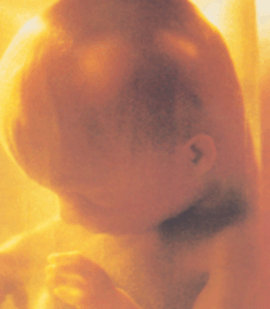
“If humans are made in God’s image, then the repercussions are serious indeed. In the ancient world, to deface the image of the king or deity was tantamount to high treason. If one did not want to live in his realm or under his kingship, that could be arranged, either by exile or death. If we take the Genesis 1 account seriously, namely, that every human being is made in God’s image, then we need to know that any act of abuse against another human being is an act of high treason against God whose image we bear witness. With this in mind, it is not hard to comprehend why Jews and Christians have historically put such a high value on human life, whether women, slaves, gladiators, newly born, or even unborn children.”
-Rikki E. Watts, in his essay On the Edge of the Millenium: Making Sense of Genesis 1.
Thursday, October 05, 2006
Dr. Miravalle's Response To 7 Common Objections To Mary As Co-Redemptrix: Objection 6
Objection 6: On a more speculative theological level, it appears that Mary cannot participate in the acquisition of the graces of redemption—or "objective redemption"—as the Co-redemptrix when she herself needed to be redeemed. If she did cooperate in objective redemption, it is because without her, objective redemption has not been accomplished. But if objective redemption has indeed not been accomplished, then she herself cannot benefit from it personally. This would be to accept that at the same time objective redemption is in the act of being accomplished and has already been accomplished, which would be a contradiction.
Response:
This apparent contradiction is removed with the proper understanding of how Mary received what is called "preservative redemption" in light of the foreseen merits of Jesus Christ on the cross.
It is true that Mary needed to be "redeemed" in order to actively participate in the process of Redemption as the sinless partner, the New Eve, with and under Jesus Christ, the New Adam. To have original sin or its effects would not allow Mary to be completely united with the Redeemer and in "enmity" or complete opposition from Satan and his seed of sin and its effects (cf. Gen. 3:15) in the redeeming process of "buying back" the human family from Satan and restoring grace to humanity. Any sin on Mary's part would attribute to her a "double-agency," in being in some part united both to the Redeemer and to Satan. Therefore Mary, as a daughter of Adam and Eve by virtue of her humanity, needed to be redeemed in the form of being preserved from sin and its effects in order to rightly perform the task of Co-redemptrix with the Redeemer in the process of universal objective redemption.
In the papal definition of Mary's Immaculate Conception by Bl. Pope Pius IX in 1854, it states that Mary, from the first instant of her conception was freed from original sin and all its effects "in view of the merits of Jesus Christ." (65) This refers to the higher or "more sublime manner" in which Mary was redeemed, beyond all other children of Adam and Eve. In Mary's redemption, she did not have to suffer the experience of original sin and its effects, but rather through the foreseen merits of Jesus Christ at Calvary, was preserved from any experience or effect of original sin, and is thereby redeemed in a more sublime manner (and consequently, for this reason, owes more to her saving Son's redemption than any other redeemed creature).
How then specifically is Mary's redemption in the higher form of preservation from sin enacted so as to allow her to historically participate in objective redemption? This more sublime manner of redemption takes place at Calvary in the fact that the first intention of the redemptive sacrifice of Jesus Christ, (66) according to the providential plan of the Father, was to redeem his own mother, (accomplished in view of the redemption and co-redemption which would then ransom from Satan and sin the rest of the human family).
This first intention of the Redeemer to redeem Mary is in itself another manifestation of the higher and more sublime manner of Mary's redemption. The graces of this first intention of the Redeemer are then applied to Mary at the moment of her Immaculate Conception, allowing her then to become the sinless Co-redemptrix, the historical New Eve, in the objective historic redemption of Jesus Christ at Calvary. Jesus Christ first redeemed his own mother (applied to her at the moment of her conception, preserving her from sin) and then with her active co-redemption the rest of humanity at Calvary.
Therefore there is no contradiction in the historic role of the Co-redemptrix in the objective redemption at Calvary and Mary's own personal need and receipt of the graces of redemption. In virtue of her Immaculate Conception, (redemptive graces applied to her at conception in view of the future merits of Jesus Christ at Calvary), and as the first intention of Jesus Christ's redemptive sacrifice, Mary was then able to uniquely participate in the historic redemption of the rest of humanity with her Redeemer Son. As Fr. Galot well summarizes:
The first intention of the redemptive sacrifice was concerned, according to the divine plan, with the ransom of Mary, accomplished in view of our ransom...Thus, while she was associated in the sacrifice of Calvary, Mary already benefited, in advance, from the fruits of the sacrifice and acted in the capacity of a ransomed creature. But she truly cooperated in the objective redemption, in the acquisition of the graces of salvation for all of mankind. Her redemption was purchased before that of other human beings. Mary was ransomed only by Christ, so that mankind could be ransomed with the collaboration of his mother...
Hence there is no contradiction: Marian co-redemption implies the foreseen redemption of Mary, but not the foreseen fulfillment of the redemption of mankind; it expresses the unique situation of the mother who, while having received a singular grace from her own Son, cooperates with Him in the attainment of salvation for all.
Still other theological schools prefer to distinguish the general notion of redemption into the two categories of "preservation" and "ransoming." Since Mary was never technically under the slavery of Satan's bondage since she never experienced sin, then the term "ransom" is less accurate for her, as it infers returning someone from a previous slavery. Hence the term, "preservation" or preservative redemption may more accurately distinguish the uniqueness of Mary's need to be redeemed by Christ first and as a daughter of Adam and Eve, but does not infer that she was ever under Satan's slavery of sin, illustrative of her higher form of preservative redemption and her subsequent participation in the true "ransoming" of the rest of humanity.
Does this primordial intention of Jesus Christ to redeem his mother and then, as subsequent intention, the rest of humanity violate the "one sacrifice" of Jesus Christ offered for all as discussed in Hebrews (cf. Heb. 10:10)? It does not, as the redemption remains one, although its intentions and efficacious applications are twofold. The one redemptive sacrifice of Jesus Christ at Calvary does not constitute "two redemptions," but one sublime redemption with two saving applications: the first application effecting the Immaculate Conception of Mary and thus preparing her to be the Co-redemptrix in her cooperation in objective redemption; the second application effecting the redemption of the human family accomplished with the Co-redemptrix.
In his homily on the Feast of Immaculate Conception in the cathedral in Krakow, Karol Cardinal Wojtyla (the present pontiff) well summarized this Marian truth: "In order to be the Co-redemptrix, she was first the Immaculate Conception."
Response:
This apparent contradiction is removed with the proper understanding of how Mary received what is called "preservative redemption" in light of the foreseen merits of Jesus Christ on the cross.
It is true that Mary needed to be "redeemed" in order to actively participate in the process of Redemption as the sinless partner, the New Eve, with and under Jesus Christ, the New Adam. To have original sin or its effects would not allow Mary to be completely united with the Redeemer and in "enmity" or complete opposition from Satan and his seed of sin and its effects (cf. Gen. 3:15) in the redeeming process of "buying back" the human family from Satan and restoring grace to humanity. Any sin on Mary's part would attribute to her a "double-agency," in being in some part united both to the Redeemer and to Satan. Therefore Mary, as a daughter of Adam and Eve by virtue of her humanity, needed to be redeemed in the form of being preserved from sin and its effects in order to rightly perform the task of Co-redemptrix with the Redeemer in the process of universal objective redemption.
In the papal definition of Mary's Immaculate Conception by Bl. Pope Pius IX in 1854, it states that Mary, from the first instant of her conception was freed from original sin and all its effects "in view of the merits of Jesus Christ." (65) This refers to the higher or "more sublime manner" in which Mary was redeemed, beyond all other children of Adam and Eve. In Mary's redemption, she did not have to suffer the experience of original sin and its effects, but rather through the foreseen merits of Jesus Christ at Calvary, was preserved from any experience or effect of original sin, and is thereby redeemed in a more sublime manner (and consequently, for this reason, owes more to her saving Son's redemption than any other redeemed creature).
How then specifically is Mary's redemption in the higher form of preservation from sin enacted so as to allow her to historically participate in objective redemption? This more sublime manner of redemption takes place at Calvary in the fact that the first intention of the redemptive sacrifice of Jesus Christ, (66) according to the providential plan of the Father, was to redeem his own mother, (accomplished in view of the redemption and co-redemption which would then ransom from Satan and sin the rest of the human family).
This first intention of the Redeemer to redeem Mary is in itself another manifestation of the higher and more sublime manner of Mary's redemption. The graces of this first intention of the Redeemer are then applied to Mary at the moment of her Immaculate Conception, allowing her then to become the sinless Co-redemptrix, the historical New Eve, in the objective historic redemption of Jesus Christ at Calvary. Jesus Christ first redeemed his own mother (applied to her at the moment of her conception, preserving her from sin) and then with her active co-redemption the rest of humanity at Calvary.
Therefore there is no contradiction in the historic role of the Co-redemptrix in the objective redemption at Calvary and Mary's own personal need and receipt of the graces of redemption. In virtue of her Immaculate Conception, (redemptive graces applied to her at conception in view of the future merits of Jesus Christ at Calvary), and as the first intention of Jesus Christ's redemptive sacrifice, Mary was then able to uniquely participate in the historic redemption of the rest of humanity with her Redeemer Son. As Fr. Galot well summarizes:
The first intention of the redemptive sacrifice was concerned, according to the divine plan, with the ransom of Mary, accomplished in view of our ransom...Thus, while she was associated in the sacrifice of Calvary, Mary already benefited, in advance, from the fruits of the sacrifice and acted in the capacity of a ransomed creature. But she truly cooperated in the objective redemption, in the acquisition of the graces of salvation for all of mankind. Her redemption was purchased before that of other human beings. Mary was ransomed only by Christ, so that mankind could be ransomed with the collaboration of his mother...
Hence there is no contradiction: Marian co-redemption implies the foreseen redemption of Mary, but not the foreseen fulfillment of the redemption of mankind; it expresses the unique situation of the mother who, while having received a singular grace from her own Son, cooperates with Him in the attainment of salvation for all.
Still other theological schools prefer to distinguish the general notion of redemption into the two categories of "preservation" and "ransoming." Since Mary was never technically under the slavery of Satan's bondage since she never experienced sin, then the term "ransom" is less accurate for her, as it infers returning someone from a previous slavery. Hence the term, "preservation" or preservative redemption may more accurately distinguish the uniqueness of Mary's need to be redeemed by Christ first and as a daughter of Adam and Eve, but does not infer that she was ever under Satan's slavery of sin, illustrative of her higher form of preservative redemption and her subsequent participation in the true "ransoming" of the rest of humanity.
Does this primordial intention of Jesus Christ to redeem his mother and then, as subsequent intention, the rest of humanity violate the "one sacrifice" of Jesus Christ offered for all as discussed in Hebrews (cf. Heb. 10:10)? It does not, as the redemption remains one, although its intentions and efficacious applications are twofold. The one redemptive sacrifice of Jesus Christ at Calvary does not constitute "two redemptions," but one sublime redemption with two saving applications: the first application effecting the Immaculate Conception of Mary and thus preparing her to be the Co-redemptrix in her cooperation in objective redemption; the second application effecting the redemption of the human family accomplished with the Co-redemptrix.
In his homily on the Feast of Immaculate Conception in the cathedral in Krakow, Karol Cardinal Wojtyla (the present pontiff) well summarized this Marian truth: "In order to be the Co-redemptrix, she was first the Immaculate Conception."
Subscribe to:
Posts (Atom)