"See what love the Father has given us,
that we should be called children of God; and so we are."
-1 John 3:1
Wednesday, January 14, 2015
As Catholics, Let Us Reject The "Deuterocanonicals"!
Saturday, January 05, 2013
Von Balthasar's Aesthetical Approach To Scripture
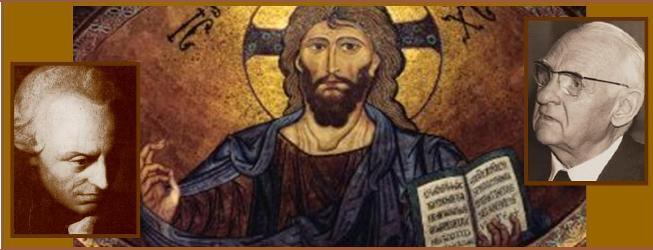
In the first book of the first part of Hans Urs von Balthasar’s Trilogy, The Glory of the Lord: Seeing the Form, von Balthasar lays out his plan for a theological aesthetics. He envisions his project as a reversal of the ordering of the transcendentals in the works of Immanuel Kant. Kant began with his critique of pure reason (truth), then moved to a critique of practical reason (good), and finally a critique of judgment (beauty). Thus, von Balthasar begins where Kant ends and affirms that without beauty as the starting point, the other transcendentals are lost. ...
Continue reading my most recent article, Obstacles to Reading Scripture in Modernity: Von Balthasar's Response, over at Homiletic & Pastoral Review.
Sunday, March 06, 2011
Blessings And Curses
Sunday, October 31, 2010
Contradictions In Scripture?
“then the LORD God formed man of dust from the ground, and breathed into his nostrils the breath of life; and man became a living being. And the LORD God planted a garden in Eden, in the east; and there he put the man whom he had formed. And out of the ground the LORD God made to grow every tree that is pleasant to the sight and good for food”
The sixth rule Tichonius calls the recapitulation, which, with sufficient watchfulness, is discovered in difficult parts of Scripture. For certain occurrences are so related, that the narrative appears to be following the order of time, or the continuity of events, when it really goes back without mentioning it to previous occurrences, which had been passed over in their proper place. And we make mistakes if we do not understand this, from applying the rule here spoken of. For example, in the book of Genesis we read, "And the Lord God planted a garden eastwards in Eden; and there He put the man whom He had formed. And out of the ground made the Lord God to grow every tree that is pleasant to the sight, and good for food." Now here it seems to be indicated that the events last mentioned took place after God had formed man and put him in the garden; whereas the fact is, that the two events having been briefly mentioned, viz., that God planted a garden, and there put the man whom He had formed, the narrative goes back, by way of recapitulation, to tell what had before been omitted, the way in which the garden was planted: that out of the ground God made to grow every tree that is pleasant to the sight, and good for food. Here there follows "The tree of life also was in the midst of the garden, and the tree of knowledge of good and evil." Next the river is mentioned which watered the garden, and which was parted into four heads, the sources of four streams; and all this has reference to the arrangements of the garden. And when this is finished, there is a repetition of the fact which had been already told, but which in the strict order of events came after all this: "And the Lord God took the man, and put him into the garden of Eden." For it was after all these other things were done that man was put in the garden, as now appears from the order of the narrative itself: it was not after man was put there that the other things were done, as the previous statement might be thought to imply, did we not accurately mark and understand the recapitulation by which the narrative reverts to what had previously been passed over.
Friday, October 22, 2010
The Text In Its Final Form
Thursday, October 14, 2010
Book Review: Exploring Jewish Literature of the Second Temple Period
Size: 6 x 9 inches
Binding: paperback
Publisher: IVP Academic (July 2002)
ISBN: 0-8308-2678-5
IVP Order Code: 2678
Wednesday, September 29, 2010
Who's Dwelling In Shem's Tent?
Sunday, August 22, 2010
The Ten Commandments: An Echo Of The Creation
Monday, August 16, 2010
Did Paul Invent Christianity?
Sunday, August 15, 2010
Scheeben On The Theological Principles Of The Assumption Of Mary Premised By The Sacred Scriptures
Saturday, June 19, 2010
Book Review: The Old Testament Documents
Length: 239 pages
Size: 5 1/2 x 8 1/4 inches
Binding: paperback
Publisher: IVP Academic (August 2001)
ISBN: 978-0-8308-1975-1
IVP Order Code: 1975
With the wasteland of scholarship that exists in modern biblical studies, it is refreshing to find a scholar who approaches the Old Testament texts as the Word of God. That scholar is Walter C. Kaiser Jr., president emeritus and Colman M. Mockler Distinguished Professor of Old Testament at Gordon-Conwell Theological Seminary. Kaiser envisions his The Old Testament Documents: Are They Reliable & Relevant? as a companion volume to the classic work by F.F. Bruce, The New Testament Documents: Are They Reliable?
Kaiser’s book serves as a refreshing introduction to the Old Testament. The books are judged on their own merit and based on their own claims—which are to be the revelation of God given to His people. He lays great importance in discovering what the texts, as they stand, mean to us. The several books are united by virtue of being the Word of God and so they should be read as a unity, each individual book having its place in the wider narrative of salvation history. With this hermeneutic in mind, he brings to light evidence against the tendency to break up individual books (specifically the Pentateuch) into little pieces in hopes of finding supposed sources, such as the Wellhausenian J, E, P, and D.
The greatest treasure of this book is the copious amounts of archeological corroboration Kaiser uses to show that the Old Testament documents are indeed reliable. One such example is of the walls at Jericho, which in the biblical account fell after Joshua led his army around while blowing trumpets. Many modern scholars doubt that this evident ever happened, or at least not as is told in the book of Joshua. Yet, Kaiser explains that the archeological excavations done at Jericho show that the walls fell outward supporting Joshua’s description that the walls “fell down flat” (Josh. 6:20) making it so that every man could charge straight into the city. Also, the mass amounts of grain found in the city support the biblical account of a swift fall of Jericho, rather than a long siege in which the attackers waited for the inhabitants to starve.
Kaiser also talks about the Old Testament Canon and here is where I, as a Catholic, disagree with the eminent Protestant. Kaiser and other Protestants affirm only 39 books of the Old Testament as Canonical (they leave out Tobit, Judith, Wisdom of Solomon, Ecclesiasticus [also known as Sirach], Baruch, and 1 and 2 Maccabees), whereas Catholics hold that there are 46 books. Kaiser asks the question, “Who…made the decision as to what books were to be included in the canon and what were the criteria that were used?” He answers his question by stating, “The answer we could give is that there is no evidence that any group, council, or any other religious or nonreligious body made such as decision, much less left a clue as to what their criteria were.” This is simply false.
The Christian Canon of the Old Testament was established first in 382 at the Council of Rome which was held under Pope Damasus. Here is what is has to say:
“Likewise it has been said: Now indeed we must treat of the divine Scriptures, what the universal Catholic Church accepts and what she ought to shun.
The order of the Old Testament begins here: Genesis one book, Exodus one book, Leviticus one book, Numbers one book, Deuteronomy one book, Josue Nave one book, Judges one book, Ruth one book, Kings four books (meaning 1 and 2 Samuel and 1 and 2 Kings), Paralipomenon two books (1 and 2 Chronicles), Psalms one book, Solomon three books, Proverbs one book, Ecclesiastes one book, Canticle of Canticles one book, likewise Wisdom one book, Ecclesiasticus (Sirach) one book.
Likewise the order of the Prophets. Isaias one book, Jeremias one book (Baruch is included here), with Ginoth, that is, with his lamentations, Ezechiel one book, Daniel one book, Osee (Hosea) one book, Amos one book, Micheas (Micah) one book, Joel one book, Abdias (Obadiah) one book, Jonas (Jonah) one book, Nahum one book, Habacuc one book, Sophonias (Zephaniah) one book, Aggeus (Haggai) one book, Zacharias one book, Malachias one book.
Likewise the order of the histories. Job one book, Tobias one book, Esdras two books (Ezra and Nehemiah), Esther one book, Judith one book, Machabees two books.
Notice that there isn’t any talk of a “second-canon” or “deuterocanonical” books. There was only ONE canon of Sacred Scripture. The seven books that the Protestants reject never had a secondary status! The later councils of Hippo and Carthage (393 and 397) both affirmed the same books as being canonical. Then in 405, Pope Innocent I in his epistle “Consulenti tibi” to Exuperius, Bishop of Toulouse, enumerates the same books that were listed at Rome, Hippo, and Carthage as being canonical. From here on until 1442 there is no more talk of the canon amongst the Popes or councils of the Church. The Council of Florence in 1442 lists the same as has been listed previously, again with no mention of a second canon. There has always only been ONE canon, and one alone. Then in 1546, at the Council of Trent, the Church reaffirms the list found at Florence in reaction against the Protestants taking out of the seven books mentioned previously. Thus, history witnesses against Kaiser’s claim that “At the Council of Trent (A.D. 1546), the Roman Catholic Church also added as canonical [the seven books]…though always with a secondary or deuterocanonical status.” Although, to Kaiser’s credit, he does not try to invoke the oft used myth that a council of rabbis took place at Jamnia which settled the Hebrew canon in 90 A.D. Instead, he firmly rejects the notion and states that all that took place at Jamnia was a discussion on how to interpret the books of Ecclesiastes and the Song of Solomon. There was no mention of their canonical status. On top of all that, if Jamnia did settle the Jewish canon, which it did not, why would the Church be bound to accept it? It wouldn’t and any notion that it should is to be rejected as ludicrous.
Canon issues aside, the book on a whole is a great introduction to the Old Testament. Are the texts reliable and relevant? Walter Kaiser is no Marcionite and the answer is a definite “Yes!” I highly recommend this book to all and praise IVP Academic for publishing it. It is books like this that makes Intervarsity Press one of my favorite publishers! Many thanks once again to Heather Mascarello and the good folks at InterVarsity Press who have provided me with a review copy of The Old Testament Documents by Walter Kaiser.
Wednesday, June 16, 2010
Two Creation Accounts?
Here is a good summary of the reasons to reject the Documentary Hypothesis concerning Genesis 1-2.
Another point concerning the two names for God found in Gen. 1 and 2, that the author of the article did not mention, is that since Gen. 1 describes a broad view of creation, the generic name for God ("Elohim") is used. Whereas in the more intimate account of creation in Gen. 2 focusing on man, the covenant name for God ("Yahweh") is used, which is entirely fitting.
Saturday, April 03, 2010
The Biblical View Of Covenant
“In the Bible, what we call ‘covenant’ is not a symmetrical relationship between two partners who make a contractual agreement involving reciprocal obligations and penalties: this idea of a partnership among equals cannot be reconciled with the biblical concept of God. According to the latter, man is in no position to create a relationship with God, let alone give him anything and receive something in return; it is quite out of the question that man should bind God to obligations in return for undertakings on his own part. If there is to be a relationship between God and man, it can only come about through God’s free ordinance, in which his sovereignty remains intact. The relationship is therefore completely asymmetrical, because God, for the creature, is and remains the ‘wholly other.’ The ‘covenant’ is not a two-sided contract but a gift, a creative act of God’s love. This last statement, it is true, goes beyond the philological issue. Although the covenant is patterned on Hittite and Assyrian contracts between states, in which the lord imposes his law on his vassal, God’s covenant with Israel is far more: here God, the King, receives nothing from man; but in giving him his law, he gives him the path of life.”
-Joseph Cardinal Ratzinger, Many Religions—One Covenant: Israel, the Church and the World