Quote Of The Day
"The Church, which had already been conceived and which issued, as it were, from the loins of the New Adam when he slept on the cross, was dazzlingly manifested to men for the first time on the solemn day of Pentecost."
-Pope Leo XIII, from his encyclical Divinum Illud.
Tuesday, April 11, 2006

Monday, April 10, 2006
Society for the Renewal of the Sacred Liturgy
I heard about this on Relevant Radio today:
Adoremus - Society for the Renewal of the Sacred Liturgy is an association of Catholics established on the Feast of Saints Peter and Paul 1995, to promote authentic reform of the Liturgy of the Roman Rite.
The mission of Adoremus is to rediscover and restore the beauty, the holiness, the power of the Church's rich liturgical tradition while remaining faithful to an organic, living process of renewal. The purpose of such a renewal cannot be stated more eloquently than this statement by Cardinal Joseph Ratzinger:
Christian Liturgy is cosmic Liturgy, as Saint Paul tells us in the Letter to the Philippians. It must never renounce this dignity, however attractive it may seem to work with small groups and construct homemade liturgies. What is exciting about Christian Liturgy is that it lifts us up out of our narrow sphere and lets us share in the Truth. The aim of all liturgical renewal must be to bring to light this liberating greatness. -- Feast of Faith
I heard about this on Relevant Radio today:
Adoremus - Society for the Renewal of the Sacred Liturgy is an association of Catholics established on the Feast of Saints Peter and Paul 1995, to promote authentic reform of the Liturgy of the Roman Rite.
The mission of Adoremus is to rediscover and restore the beauty, the holiness, the power of the Church's rich liturgical tradition while remaining faithful to an organic, living process of renewal. The purpose of such a renewal cannot be stated more eloquently than this statement by Cardinal Joseph Ratzinger:
Christian Liturgy is cosmic Liturgy, as Saint Paul tells us in the Letter to the Philippians. It must never renounce this dignity, however attractive it may seem to work with small groups and construct homemade liturgies. What is exciting about Christian Liturgy is that it lifts us up out of our narrow sphere and lets us share in the Truth. The aim of all liturgical renewal must be to bring to light this liberating greatness. -- Feast of Faith
All Catechism, All The Time!
I've been waiting anxiously to post this, and now that Moneybags over at A Catholic Life has announced it, I guess I can as well!
This Easter Sunday, will be the start of a great new project called the Catholic Catechism Dialogue Blog. We will be going through the whole Catechism in one year and writing meditations on the CCC. The site is hosted by Owen from Luminous Miseries II.
Be sure to check it out and comment frequently!
I've been waiting anxiously to post this, and now that Moneybags over at A Catholic Life has announced it, I guess I can as well!
This Easter Sunday, will be the start of a great new project called the Catholic Catechism Dialogue Blog. We will be going through the whole Catechism in one year and writing meditations on the CCC. The site is hosted by Owen from Luminous Miseries II.
Be sure to check it out and comment frequently!
Sunday, April 09, 2006
The Catholic Church
The Catholic Church is a "standard among all nations," as the [First] Vatican Council puts it, following Isaiah. She is a rallying point for all, "inviting those who as yet have no faith, and assuring her own children that the faith which they profess has the fimest of foundations." She is the mountain visible from afar, the radiant city, the light set in a candlestick to illuminate the whole house. She is the imperishable building of cedar and cypress, which defies the passage of time in its awe-inspiring massiveness and gives to our ephemeral individualities their measure of confidence. She is the "continual miracle," always announcing to men the coming of their Savior and manifesting his liberating power in examples without number; the magnificent vaulting under which the saints, like so many stars, sing together of the glory of the Redeemer. Through the depth and cohesion of the doctrine she puts forward, her experience of men, and the fruits the Holy Spirit continually ripens in her, the Church exercises over people of spiritual integrity an attraction that is witnessed to throughout history by a vast number of conversions, which are, humanly speaking, startling in the extreme. As the depositary and guardian of Scripture, she is the diffusion point for its illuminating power, which alone can make our history intelligible. And thus she leads us to Christ by many ways, all of which converge. In her, God makes himself continually visible to the eyes of those "who see wisdom"; anyone who has given himself to her with his eyes open proves it for himself again and again:
Haec est cymba qua tuti vehimur,
Hoc ovile quo tecte condimur,
Haec columna qua firmi nitimur
Veritatis!
To a man who lives her mystery, she is always the city of precious stones, the Heavenly Jerusalem, the Bride of the Lamb, as she was to St. John; and seeing her thus, he feels that very joy which bursts through the light-split skies of the Apocalypse and glows in its visions of serenity. One begins to understand what makes him cry, like St. Augustine: "When I talk about her, I cannot stop."
-Henri De Lubac
The Catholic Church is a "standard among all nations," as the [First] Vatican Council puts it, following Isaiah. She is a rallying point for all, "inviting those who as yet have no faith, and assuring her own children that the faith which they profess has the fimest of foundations." She is the mountain visible from afar, the radiant city, the light set in a candlestick to illuminate the whole house. She is the imperishable building of cedar and cypress, which defies the passage of time in its awe-inspiring massiveness and gives to our ephemeral individualities their measure of confidence. She is the "continual miracle," always announcing to men the coming of their Savior and manifesting his liberating power in examples without number; the magnificent vaulting under which the saints, like so many stars, sing together of the glory of the Redeemer. Through the depth and cohesion of the doctrine she puts forward, her experience of men, and the fruits the Holy Spirit continually ripens in her, the Church exercises over people of spiritual integrity an attraction that is witnessed to throughout history by a vast number of conversions, which are, humanly speaking, startling in the extreme. As the depositary and guardian of Scripture, she is the diffusion point for its illuminating power, which alone can make our history intelligible. And thus she leads us to Christ by many ways, all of which converge. In her, God makes himself continually visible to the eyes of those "who see wisdom"; anyone who has given himself to her with his eyes open proves it for himself again and again:
Haec est cymba qua tuti vehimur,
Hoc ovile quo tecte condimur,
Haec columna qua firmi nitimur
Veritatis!
To a man who lives her mystery, she is always the city of precious stones, the Heavenly Jerusalem, the Bride of the Lamb, as she was to St. John; and seeing her thus, he feels that very joy which bursts through the light-split skies of the Apocalypse and glows in its visions of serenity. One begins to understand what makes him cry, like St. Augustine: "When I talk about her, I cannot stop."
-Henri De Lubac
Friday, April 07, 2006
UGHH!
Last night at work, I was reading "A Shorter Summa: The essential philosophical passages of St. Thomas Aquinas' Summa Theologica edited and explained" by Peter Kreeft. When my break was over I got up to return to work, when the man next to me (a regular customer) asked what I was reading. I told him it was selections of St. Thomas's Summa Theologica. I wasn't sure if he knew who St. Thomas was, so I explained that the Summa was his great work on theology and philosophy.
He then asked if I had ever heard of Alan Watts. I said no. Then he told me that he read one of his books when he was 29 (he is 65 now) and he was very lucky to do so. He then said, "St. Thomas doesn't hold up."
At which point I thought, "oookaaay."
As I started to go back to work with a shrug of my shoulders, he kept repeating, "St. Thomas doesn't hold up, St. Thomas doesn't hold up."
Now, at this point I'm thinking, "hmm...I bet you that Alan Watts was either an atheist or something of the sort."
Well, upon further research, it was discovered that he was an Episcopal priest (see, atheist or something of the sort) who was educated at Seabury-Western (red flags all around!).
Then I found out that he was a Buddhist since the age of 16.
It appears that the only reason he went to Seabury-Western was because he didn't have a profession and he wished to sidestep the draft for World War II (Yes, for all the non-Epsicopalians out there, they let anyone into their seminaries to be ordained priests; buddhists, witches, mormons, atheists...you name it).
He left the priesthood in 1950 after having an affair. (Sounds typical of liberal Episcopal priests. Only, most don't leave the priesthood. Some get elected Bishop of New Hampshire!)
Gotta love the culture of relativism that pervades the world these days...NOT!
Last night at work, I was reading "A Shorter Summa: The essential philosophical passages of St. Thomas Aquinas' Summa Theologica edited and explained" by Peter Kreeft. When my break was over I got up to return to work, when the man next to me (a regular customer) asked what I was reading. I told him it was selections of St. Thomas's Summa Theologica. I wasn't sure if he knew who St. Thomas was, so I explained that the Summa was his great work on theology and philosophy.
He then asked if I had ever heard of Alan Watts. I said no. Then he told me that he read one of his books when he was 29 (he is 65 now) and he was very lucky to do so. He then said, "St. Thomas doesn't hold up."
At which point I thought, "oookaaay."
As I started to go back to work with a shrug of my shoulders, he kept repeating, "St. Thomas doesn't hold up, St. Thomas doesn't hold up."
Now, at this point I'm thinking, "hmm...I bet you that Alan Watts was either an atheist or something of the sort."
Well, upon further research, it was discovered that he was an Episcopal priest (see, atheist or something of the sort) who was educated at Seabury-Western (red flags all around!).
Then I found out that he was a Buddhist since the age of 16.
It appears that the only reason he went to Seabury-Western was because he didn't have a profession and he wished to sidestep the draft for World War II (Yes, for all the non-Epsicopalians out there, they let anyone into their seminaries to be ordained priests; buddhists, witches, mormons, atheists...you name it).
He left the priesthood in 1950 after having an affair. (Sounds typical of liberal Episcopal priests. Only, most don't leave the priesthood. Some get elected Bishop of New Hampshire!)
Gotta love the culture of relativism that pervades the world these days...NOT!
Benedict's Call
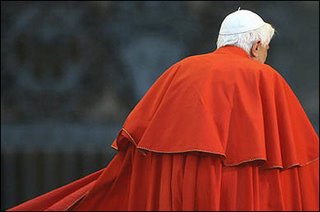
From the Star-Telegram
Pope Benedict XVI became convinced that he should become a priest to help confront the "anti-human culture" of the Nazis in his native Germany, he said during a meeting with thousands of youths in St. Peter's Square on Thursday.
Asked by one student how he realized his own priestly vocation, the pope said that when he was young in Germany it was more "normal" to accept faith and vocations than it is today.
"There was the Nazi regime," said Benedict, 78. "We were told very loudly that in the new Germany 'there will not be any more priests, there will be no more consecrated life, we don't need this anymore, find another profession.'"
"But actually hearing these loud voices, I understood that in confronting the brutality of this system, this inhuman face, that there is a need for priests, precisely as a contrast to this anti-human culture," he said.
Benedict was enrolled in the Hitler Youth as a teen and deserted from the German army near the end of World War II.
The pope acknowledged that he had doubts about the commitment required for joining the priesthood and whether his love for theology was enough reason to be ordained.
"I asked myself if I really had the capacity to live an entirely celibate life," he said.
"Being a theoretical and not practical man, I also knew it wasn't enough to love theology to be a good priest, but I also needed to be available to young people, old, sick and poor people."
He said that in the end, God as well as friends and other priests helped him to decide.
The meeting was the second in which he has publicly fielded questions from young Catholics.
h/t for picture American Papist
From the Star-Telegram
Pope Benedict XVI became convinced that he should become a priest to help confront the "anti-human culture" of the Nazis in his native Germany, he said during a meeting with thousands of youths in St. Peter's Square on Thursday.
Asked by one student how he realized his own priestly vocation, the pope said that when he was young in Germany it was more "normal" to accept faith and vocations than it is today.
"There was the Nazi regime," said Benedict, 78. "We were told very loudly that in the new Germany 'there will not be any more priests, there will be no more consecrated life, we don't need this anymore, find another profession.'"
"But actually hearing these loud voices, I understood that in confronting the brutality of this system, this inhuman face, that there is a need for priests, precisely as a contrast to this anti-human culture," he said.
Benedict was enrolled in the Hitler Youth as a teen and deserted from the German army near the end of World War II.
The pope acknowledged that he had doubts about the commitment required for joining the priesthood and whether his love for theology was enough reason to be ordained.
"I asked myself if I really had the capacity to live an entirely celibate life," he said.
"Being a theoretical and not practical man, I also knew it wasn't enough to love theology to be a good priest, but I also needed to be available to young people, old, sick and poor people."
He said that in the end, God as well as friends and other priests helped him to decide.
The meeting was the second in which he has publicly fielded questions from young Catholics.
h/t for picture American Papist
Thursday, April 06, 2006
Whether man has free-will?
Objection 1: It would seem that man has not free-will. For whoever has free-will does what he wills. But man does not what he wills; for it is written (Rm. 7:19): "For the good which I will I do not, but the evil which I will not, that I do." Therefore man has not free-will.
Objection 2: Further, whoever has free-will has in his power to will or not to will, to do or not to do. But this is not in man's power: for it is written (Rm. 9:16): "It is not of him that willeth"---namely, to will---"nor of him that runneth"---namely, to run. Therefore man has not free-will.
Objection 3: Further, what is "free is cause of itself," as the Philosopher says (Metaph. i, 2). Therefore what is moved by another is not free. But God moves the will, for it is written (Prov. 21:1): "The heart of the king is in the hand of the Lord; whithersoever He will He shall turn it" and (Phil. 2:13): "It is God Who worketh in you both to will and to accomplish." Therefore man has not free-will.
Objection 4: Further, whoever has free-will is master of his own actions. But man is not master of his own actions: for it is written (Jer. 10:23): "The way of a man is not his: neither is it in a man to walk." Therefore man has not free-will.
Objection 5: Further, the Philosopher says (Ethic. iii, 5): "According as each one is, such does the end seem to him." But it is not in our power to be of one quality or another; for this comes to us from nature. Therefore it is natural to us to follow some particular end, and therefore we are not free in so doing.
On the contrary, It is written (Ecclus. 15:14): "God made man from the beginning, and left him in the hand of his own counsel"; and the gloss adds: "That is of his free-will."
I answer that, Man has free-will: otherwise counsels, exhortations, commands, prohibitions, rewards, and punishments would be in vain. In order to make this evident, we must observe that some things act without judgment; as a stone moves downwards; and in like manner all things which lack knowledge. And some act from judgment, but not a free judgment; as brute animals. For the sheep, seeing the wolf, judges it a thing to be shunned, from a natural and not a free judgment, because it judges, not from reason, but from natural instinct. And the same thing is to be said of any judgment of brute animals. But man acts from judgment, because by his apprehensive power he judges that something should be avoided or sought. But because this judgment, in the case of some particular act, is not from a natural instinct, but from some act of comparison in the reason, therefore he acts from free judgment and retains the power of being inclined to various things. For reason in contingent matters may follow opposite courses, as we see in dialectic syllogisms and rhetorical arguments. Now particular operations are contingent, and therefore in such matters the judgment of reason may follow opposite courses, and is not determinate to one. And forasmuch as man is rational is it necessary that man have a free-will.
Reply to Objection 1: As we have said above (Question [81], Article [3], ad 2), the sensitive appetite, though it obeys the reason, yet in a given case can resist by desiring what the reason forbids. This is therefore the good which man does not when he wishes---namely, "not to desire against reason," as Augustine says.
Reply to Objection 2: Those words of the Apostle are not to be taken as though man does not wish or does not run of his free-will, but because the free-will is not sufficient thereto unless it be moved and helped by God.
Reply to Objection 3: Free-will is the cause of its own movement, because by his free-will man moves himself to act. But it does not of necessity belong to liberty that what is free should be the first cause of itself, as neither for one thing to be cause of another need it be the first cause. God, therefore, is the first cause, Who moves causes both natural and voluntary. And just as by moving natural causes He does not prevent their acts being natural, so by moving voluntary causes He does not deprive their actions of being voluntary: but rather is He the cause of this very thing in them; for He operates in each thing according to its own nature.
Reply to Objection 4: "Man's way" is said "not to be his" in the execution of his choice, wherein he may be impeded, whether he will or not. The choice itself, however, is in us, but presupposes the help of God.
Reply to Objection 5: Quality in man is of two kinds: natural and adventitious. Now the natural quality may be in the intellectual part, or in the body and its powers. From the very fact, therefore, that man is such by virtue of a natural quality which is in the intellectual part, he naturally desires his last end, which is happiness. Which desire, indeed, is a natural desire, and is not subject to free-will, as is clear from what we have said above (Question [82], Articles [1],2). But on the part of the body and its powers man may be such by virtue of a natural quality, inasmuch as he is of such a temperament or disposition due to any impression whatever produced by corporeal causes, which cannot affect the intellectual part, since it is not the act of a corporeal organ. And such as a man is by virtue of a corporeal quality, such also does his end seem to him, because from such a disposition a man is inclined to choose or reject something. But these inclinations are subject to the judgment of reason, which the lower appetite obeys, as we have said (Question [81], Article [3]). Wherefore this is in no way prejudicial to free-will.
The adventitious qualities are habits and passions, by virtue of which a man is inclined to one thing rather than to another. And yet even these inclinations are subject to the judgment of reason. Such qualities, too, are subject to reason, as it is in our power either to acquire them, whether by causing them or disposing ourselves to them, or to reject them. And so there is nothing in this that is repugnant to free-will.
-St. Thomas Aquinas, Summa Theologica I,83,1
...And in case one doesn't want to take St. Aquinas's word for it, here's what the Church Fathers say:
St. Justin Martyr (First Apology):
We have learned from the Prophets and we hold it as true that punishments and chastisments and good rewards are distributed according to the merit of each man's actions. Were this not the case, and were all things to happen according to the decree of fate, there would be nothing at all in our power. If fate decrees that this man is to be good, and that one wicked, then neither is the former to be praised nor the latter to be blamed.
Furthermore, if the human race does not have the power of a freely deliberated choice in fleeing evil and in choosing good, then men are not accountable for their actions, whatever they be. That they do, however, by a free choice, either walk upright or stumble, we shall now prove...God did not make man like the other beings, the trees and the four-legged beasts, for example, which cannot do anything by free choice.
Neither would man deserve reward or praise if he did not of himself choose good; nor, if he acted wickedly, would he deserve punishment, since he would not be evil by choice, and could not be other than that which he was born. The Holy Prophetic Spirit taught us this when He informed us through Moses that God spoke as follows to the first created man: "Behold, before your face, the good and the evil. Choose the good."
St. Justin Martyr (Dialogue With Trypho The Jew):
"Because God knew that it would be good, He created both angels and men free to do what is righteous; and He limited the times up to which He knew it would be good for them to have the exercise of free choice."
Tatian the Syrian (Address to the Greeks):
The heavenly Word, who is Spirit begotten by the Father, and Word from the rational potency, made man an image of immortality in imitation of the Father who begot Him. In that way, as incorruption pertains to God, so man, sharing in the portion of God, might have immortality too. Indeed, the Word, before ever men were made, was the Creator of the angels. Each of these species of creatures was created free, not having the nature of good, which pertains only to God, and which is brought to perfection by men through their freedom of choice. Thus, the wicked man is justly punished, having become depraved of himself; and the just man is worthy of praise for his honest deeds, since it was in his free choice that he did not transgress the will of God.
St. Theophilus of Antioch (To Autolycus):
Someone, however, will say to us, "Was man made by nature mortal?" Certainly not. "Was he, then, immortal?" Neither do we say that. But someone will say, "Was he, then, made nothing?" Not so, I reply. By nature, in fact, he was made neither mortal nor immortal. For if God had made him immortal from the beginning, He would have made him God. Again, if He had made him mortal, it would seem as if God were the cause of his death. He made him, then, neither mortal nor immortal, but, as we said above, capable of either. Thus, if he should incline to the ways of immortality, keeping the command of God, he should receive from God the reward of immortality, and become God. If, however, he turn aside to the ways of death, disobeying God, he should become for himself the cause of death. For God made man free and self-determining.
St. Irenaeus (Against Heresies):
Those words, however, in which he says: "How often would I have gathered your children together, but you would not," make clear the ancient law of human liberty; for God made man free from the beginning, so that he possessed his own power just as his own soul, to follow God's will freely, not being compelled by God. For with God there is no coercion; but a good will is present with Him always. He, therefore, gives good counsel to all. In man as well as in angels -for angels are rational- He has placed a power of choice, so that those who obeyed might justly possess the good things which, indeed, God gives, but which they themselves must preserve.
Those who have not obeyed will not be found worthy to possess the good, and will receive deserved punishment; for God did kindly bestow the good upon them, but they did not guard it carefully, nor regard it as something precious, but were contemptuous of His most eminent goodness...God, therefore, has given good, .... and they who work with it will receive glory and honor, because they have done good when they were able to do otherwise. But those who do not do it will receive God's just judgment, because they did not do good when they were able to do it.
Origen (The Fundamental Doctrines):
This also is clearly defined in ecclesiastical teaching, that every rational soul has free will and choice; also, that it has a struggle against the devil and his angels and opposing powers, in which they strive to burden it with sins, while we, if we live rightly and properly, should endeavor to shake ourselves free of any such disgrace. Whence it follows also that we do not understand ourselves as being subject to necessity, so as to be entirely compelled, even against our will, to do either evil or good. For while we make our own decisions, some powers may perhaps impel us to sin, and others help us to salvation.
We are not, however, forced by necessity to act either rightly or wrongly, as is maintained by those who say that the course and movement of the stars is the cause of human actions, and not only of those events which take place apart from the freedom of choice, but of those also which are place within our power.
Arnobius of Sicca (Against the Pagans):
"But if Christ came as the Preserver of the human race," you say, "why does He not, with equal kindness, free all without execption?" Well, does He not free all alike, when He calls all alike? Or does He repel and thrust anyone away from the supreme benevolence, when He gives to all alike the power of coming to Him -to men of rank, to common folk, to slaves, to women and boys? "The fountain of life," He says, "is open to all; nor is anyone turned away or denied the right to drink."
If you are so fastidious as to spurn the kindness of the offered gift -nay, if you are of such superior wisdom that you term what Christ offers ridiculous and absurd, why should He keep on inviting you, when it is but His part to expose the fruit of His bounty to your own free choice? Plato says that God is not the cause of any man's choosing his lot in life; nor can anyone's will be rightly imputed to another, since the freedom of will is placed within the power of the very one who wills.
Eusebius Pamphilus (Proof of the Gospel):
For when God willed it, seeing that He is the only good of good and the source and beginning of everything, many participants of His treasures were produced. It was just then that every rational creature was about to be sent forth; some as incorporeal, intelligent and divine powers, -Angels, indeed, and Archangels,- immaterial and entirely pure spirits; and besides these, there were the souls of men supplied with a nature that is independent and of free will in respect to the choosing of what is noble or its opposite.
Objection 1: It would seem that man has not free-will. For whoever has free-will does what he wills. But man does not what he wills; for it is written (Rm. 7:19): "For the good which I will I do not, but the evil which I will not, that I do." Therefore man has not free-will.
Objection 2: Further, whoever has free-will has in his power to will or not to will, to do or not to do. But this is not in man's power: for it is written (Rm. 9:16): "It is not of him that willeth"---namely, to will---"nor of him that runneth"---namely, to run. Therefore man has not free-will.
Objection 3: Further, what is "free is cause of itself," as the Philosopher says (Metaph. i, 2). Therefore what is moved by another is not free. But God moves the will, for it is written (Prov. 21:1): "The heart of the king is in the hand of the Lord; whithersoever He will He shall turn it" and (Phil. 2:13): "It is God Who worketh in you both to will and to accomplish." Therefore man has not free-will.
Objection 4: Further, whoever has free-will is master of his own actions. But man is not master of his own actions: for it is written (Jer. 10:23): "The way of a man is not his: neither is it in a man to walk." Therefore man has not free-will.
Objection 5: Further, the Philosopher says (Ethic. iii, 5): "According as each one is, such does the end seem to him." But it is not in our power to be of one quality or another; for this comes to us from nature. Therefore it is natural to us to follow some particular end, and therefore we are not free in so doing.
On the contrary, It is written (Ecclus. 15:14): "God made man from the beginning, and left him in the hand of his own counsel"; and the gloss adds: "That is of his free-will."
I answer that, Man has free-will: otherwise counsels, exhortations, commands, prohibitions, rewards, and punishments would be in vain. In order to make this evident, we must observe that some things act without judgment; as a stone moves downwards; and in like manner all things which lack knowledge. And some act from judgment, but not a free judgment; as brute animals. For the sheep, seeing the wolf, judges it a thing to be shunned, from a natural and not a free judgment, because it judges, not from reason, but from natural instinct. And the same thing is to be said of any judgment of brute animals. But man acts from judgment, because by his apprehensive power he judges that something should be avoided or sought. But because this judgment, in the case of some particular act, is not from a natural instinct, but from some act of comparison in the reason, therefore he acts from free judgment and retains the power of being inclined to various things. For reason in contingent matters may follow opposite courses, as we see in dialectic syllogisms and rhetorical arguments. Now particular operations are contingent, and therefore in such matters the judgment of reason may follow opposite courses, and is not determinate to one. And forasmuch as man is rational is it necessary that man have a free-will.
Reply to Objection 1: As we have said above (Question [81], Article [3], ad 2), the sensitive appetite, though it obeys the reason, yet in a given case can resist by desiring what the reason forbids. This is therefore the good which man does not when he wishes---namely, "not to desire against reason," as Augustine says.
Reply to Objection 2: Those words of the Apostle are not to be taken as though man does not wish or does not run of his free-will, but because the free-will is not sufficient thereto unless it be moved and helped by God.
Reply to Objection 3: Free-will is the cause of its own movement, because by his free-will man moves himself to act. But it does not of necessity belong to liberty that what is free should be the first cause of itself, as neither for one thing to be cause of another need it be the first cause. God, therefore, is the first cause, Who moves causes both natural and voluntary. And just as by moving natural causes He does not prevent their acts being natural, so by moving voluntary causes He does not deprive their actions of being voluntary: but rather is He the cause of this very thing in them; for He operates in each thing according to its own nature.
Reply to Objection 4: "Man's way" is said "not to be his" in the execution of his choice, wherein he may be impeded, whether he will or not. The choice itself, however, is in us, but presupposes the help of God.
Reply to Objection 5: Quality in man is of two kinds: natural and adventitious. Now the natural quality may be in the intellectual part, or in the body and its powers. From the very fact, therefore, that man is such by virtue of a natural quality which is in the intellectual part, he naturally desires his last end, which is happiness. Which desire, indeed, is a natural desire, and is not subject to free-will, as is clear from what we have said above (Question [82], Articles [1],2). But on the part of the body and its powers man may be such by virtue of a natural quality, inasmuch as he is of such a temperament or disposition due to any impression whatever produced by corporeal causes, which cannot affect the intellectual part, since it is not the act of a corporeal organ. And such as a man is by virtue of a corporeal quality, such also does his end seem to him, because from such a disposition a man is inclined to choose or reject something. But these inclinations are subject to the judgment of reason, which the lower appetite obeys, as we have said (Question [81], Article [3]). Wherefore this is in no way prejudicial to free-will.
The adventitious qualities are habits and passions, by virtue of which a man is inclined to one thing rather than to another. And yet even these inclinations are subject to the judgment of reason. Such qualities, too, are subject to reason, as it is in our power either to acquire them, whether by causing them or disposing ourselves to them, or to reject them. And so there is nothing in this that is repugnant to free-will.
-St. Thomas Aquinas, Summa Theologica I,83,1
...And in case one doesn't want to take St. Aquinas's word for it, here's what the Church Fathers say:
St. Justin Martyr (First Apology):
We have learned from the Prophets and we hold it as true that punishments and chastisments and good rewards are distributed according to the merit of each man's actions. Were this not the case, and were all things to happen according to the decree of fate, there would be nothing at all in our power. If fate decrees that this man is to be good, and that one wicked, then neither is the former to be praised nor the latter to be blamed.
Furthermore, if the human race does not have the power of a freely deliberated choice in fleeing evil and in choosing good, then men are not accountable for their actions, whatever they be. That they do, however, by a free choice, either walk upright or stumble, we shall now prove...God did not make man like the other beings, the trees and the four-legged beasts, for example, which cannot do anything by free choice.
Neither would man deserve reward or praise if he did not of himself choose good; nor, if he acted wickedly, would he deserve punishment, since he would not be evil by choice, and could not be other than that which he was born. The Holy Prophetic Spirit taught us this when He informed us through Moses that God spoke as follows to the first created man: "Behold, before your face, the good and the evil. Choose the good."
St. Justin Martyr (Dialogue With Trypho The Jew):
"Because God knew that it would be good, He created both angels and men free to do what is righteous; and He limited the times up to which He knew it would be good for them to have the exercise of free choice."
Tatian the Syrian (Address to the Greeks):
The heavenly Word, who is Spirit begotten by the Father, and Word from the rational potency, made man an image of immortality in imitation of the Father who begot Him. In that way, as incorruption pertains to God, so man, sharing in the portion of God, might have immortality too. Indeed, the Word, before ever men were made, was the Creator of the angels. Each of these species of creatures was created free, not having the nature of good, which pertains only to God, and which is brought to perfection by men through their freedom of choice. Thus, the wicked man is justly punished, having become depraved of himself; and the just man is worthy of praise for his honest deeds, since it was in his free choice that he did not transgress the will of God.
St. Theophilus of Antioch (To Autolycus):
Someone, however, will say to us, "Was man made by nature mortal?" Certainly not. "Was he, then, immortal?" Neither do we say that. But someone will say, "Was he, then, made nothing?" Not so, I reply. By nature, in fact, he was made neither mortal nor immortal. For if God had made him immortal from the beginning, He would have made him God. Again, if He had made him mortal, it would seem as if God were the cause of his death. He made him, then, neither mortal nor immortal, but, as we said above, capable of either. Thus, if he should incline to the ways of immortality, keeping the command of God, he should receive from God the reward of immortality, and become God. If, however, he turn aside to the ways of death, disobeying God, he should become for himself the cause of death. For God made man free and self-determining.
St. Irenaeus (Against Heresies):
Those words, however, in which he says: "How often would I have gathered your children together, but you would not," make clear the ancient law of human liberty; for God made man free from the beginning, so that he possessed his own power just as his own soul, to follow God's will freely, not being compelled by God. For with God there is no coercion; but a good will is present with Him always. He, therefore, gives good counsel to all. In man as well as in angels -for angels are rational- He has placed a power of choice, so that those who obeyed might justly possess the good things which, indeed, God gives, but which they themselves must preserve.
Those who have not obeyed will not be found worthy to possess the good, and will receive deserved punishment; for God did kindly bestow the good upon them, but they did not guard it carefully, nor regard it as something precious, but were contemptuous of His most eminent goodness...God, therefore, has given good, .... and they who work with it will receive glory and honor, because they have done good when they were able to do otherwise. But those who do not do it will receive God's just judgment, because they did not do good when they were able to do it.
Origen (The Fundamental Doctrines):
This also is clearly defined in ecclesiastical teaching, that every rational soul has free will and choice; also, that it has a struggle against the devil and his angels and opposing powers, in which they strive to burden it with sins, while we, if we live rightly and properly, should endeavor to shake ourselves free of any such disgrace. Whence it follows also that we do not understand ourselves as being subject to necessity, so as to be entirely compelled, even against our will, to do either evil or good. For while we make our own decisions, some powers may perhaps impel us to sin, and others help us to salvation.
We are not, however, forced by necessity to act either rightly or wrongly, as is maintained by those who say that the course and movement of the stars is the cause of human actions, and not only of those events which take place apart from the freedom of choice, but of those also which are place within our power.
Arnobius of Sicca (Against the Pagans):
"But if Christ came as the Preserver of the human race," you say, "why does He not, with equal kindness, free all without execption?" Well, does He not free all alike, when He calls all alike? Or does He repel and thrust anyone away from the supreme benevolence, when He gives to all alike the power of coming to Him -to men of rank, to common folk, to slaves, to women and boys? "The fountain of life," He says, "is open to all; nor is anyone turned away or denied the right to drink."
If you are so fastidious as to spurn the kindness of the offered gift -nay, if you are of such superior wisdom that you term what Christ offers ridiculous and absurd, why should He keep on inviting you, when it is but His part to expose the fruit of His bounty to your own free choice? Plato says that God is not the cause of any man's choosing his lot in life; nor can anyone's will be rightly imputed to another, since the freedom of will is placed within the power of the very one who wills.
Eusebius Pamphilus (Proof of the Gospel):
For when God willed it, seeing that He is the only good of good and the source and beginning of everything, many participants of His treasures were produced. It was just then that every rational creature was about to be sent forth; some as incorporeal, intelligent and divine powers, -Angels, indeed, and Archangels,- immaterial and entirely pure spirits; and besides these, there were the souls of men supplied with a nature that is independent and of free will in respect to the choosing of what is noble or its opposite.
Great News For The Liturgy
From the Universe Newsroom
Signs are growing that Pope Benedict XVI intends to bring the liturgy back to a more traditional form after a top Vatican official protested the use of “Do-it-Yourself” services. In a keynote speech delivered at Westminster Cathedral recently, Cardinal Francis Arinze, Prefect of the Congregation for Divine Worship and Discipline of the Sacraments, also said that individual priests should not add to or subtract from the approved rites, mentioning the practice of playing background music in particular as one practice that should stop. “The Mass is the most solemn action of the sacred liturgy, which is itself the public worship of the Church,” the cardinal said. "'Liturgy', says Pope John Paul II, 'is never anyone's private property, be it of the celebrant or of the community in which the mysteries are celebrated. Priests who faithfully celebrate Mass according to the liturgical norms, and communities which conform to those norms, quietly but eloquently demonstrate their love for the Church'. “It follows that individuals, whether they be priests or lay faithful, are not free to add or subtract any details in the approved rites of the celebration of the Holy Eucharist. A do-it-yourself mentality, an attitude of nobody-will-tell-me-what-to-do, or a defiant sting of if-you-do-not-like-my-Mass-you-can-go-to-another-parish, is not only against sound theology and ecclesiology, but also offends against common sense. Unfortunately, sometimes common sense is not very common, when we see a priest ignoring liturgical rules and installing creativity, in his case personal idiosyncrasy, as the guide to the celebration of Holy Mass. Our faith guides us and our love of Jesus and of his Church safeguards us from taking such unwholesome liberties. Aware that we are only ministers, not masters of the mysteries of Christ.” The cardinal's comments come a week after proposals were announced by a Vatican commission to outlaw the use of drums and electric guitars from church services. The commission outlined 50 proposals on reforming the liturgy, with Vatican insiders saying that the commission also proposed to increase the use of Latin during Mass. But Fr Tom Jordon from the National Conference of Priests, said he was unaware of any deviation from the Rubrics provided by the Roman Missal in the nation's churches but added that since Vatican II in was inevitable that the personality of priests shone through during Mass.
From the Universe Newsroom
Signs are growing that Pope Benedict XVI intends to bring the liturgy back to a more traditional form after a top Vatican official protested the use of “Do-it-Yourself” services. In a keynote speech delivered at Westminster Cathedral recently, Cardinal Francis Arinze, Prefect of the Congregation for Divine Worship and Discipline of the Sacraments, also said that individual priests should not add to or subtract from the approved rites, mentioning the practice of playing background music in particular as one practice that should stop. “The Mass is the most solemn action of the sacred liturgy, which is itself the public worship of the Church,” the cardinal said. "'Liturgy', says Pope John Paul II, 'is never anyone's private property, be it of the celebrant or of the community in which the mysteries are celebrated. Priests who faithfully celebrate Mass according to the liturgical norms, and communities which conform to those norms, quietly but eloquently demonstrate their love for the Church'. “It follows that individuals, whether they be priests or lay faithful, are not free to add or subtract any details in the approved rites of the celebration of the Holy Eucharist. A do-it-yourself mentality, an attitude of nobody-will-tell-me-what-to-do, or a defiant sting of if-you-do-not-like-my-Mass-you-can-go-to-another-parish, is not only against sound theology and ecclesiology, but also offends against common sense. Unfortunately, sometimes common sense is not very common, when we see a priest ignoring liturgical rules and installing creativity, in his case personal idiosyncrasy, as the guide to the celebration of Holy Mass. Our faith guides us and our love of Jesus and of his Church safeguards us from taking such unwholesome liberties. Aware that we are only ministers, not masters of the mysteries of Christ.” The cardinal's comments come a week after proposals were announced by a Vatican commission to outlaw the use of drums and electric guitars from church services. The commission outlined 50 proposals on reforming the liturgy, with Vatican insiders saying that the commission also proposed to increase the use of Latin during Mass. But Fr Tom Jordon from the National Conference of Priests, said he was unaware of any deviation from the Rubrics provided by the Roman Missal in the nation's churches but added that since Vatican II in was inevitable that the personality of priests shone through during Mass.
Knowledge Of Truth Is Power


Envoy Magazine: The bane of Protestants and Anti-Catholics!

H/T: Holy Whapping
H/T also to Northland Catholic Roundtable for providing individual pictures. (I am too technologically inadvanced to figure out how the Shrine got theirs to rotate.)
Subscribe to:
Posts (Atom)