Like a house that has vanished, so is wisdom to a fool;
and the knowledge of the ignorant is unexamined talk.
-Sirach 21:18
The well-disposed commissar: Comrade Christian, can you tell me frankly what you Christians are up to? What are you still doing in our world? What do you see as the justification for your existence? What's your job?
The Christian: First of all, we are men like any other men who are helping to build up the future.
The Commissar: I accept your first statement, and I hope that the second is true.
The Christian: We have recently become "open to the world", and some of us even have become seriously converted to the world.
The Commissar: That sounds like crafty priests' talk. It would be even better if, as "men like any other men", you had first become converted to an existence that is worthy of man. But to the point. Why are you still Christians?
The Christian: Today we are Christians come of age. We think and act on our own moral responsibility.
The Commissar: I hope so, if you say you are men. But don't you have some special belief?
The Christian: That's not so important. The main thing is the morality appropriate to the age. Today's emphasis is on brotherly love. He who loves his neighbor loves God.
The Commissar: If he existed. But since he does not exist, you do not love him.
The Christian: We love him inclusively, unobjectively.
The Commissar: Ah, so your belief is without an object. We're making progress. Things are getting clearer.
The Christian: It's not quite so simple as that. We believe in Christ.
The Commissar: I've heard of him. But it seems we know little about him historically.
The Christian: Granted. Virtually nothing. That is why we believe less in the historical Jesus than in the Christ of the kerygma.
The Commissar: What's that word? Chinese?
The Christian: Greek. It means the proclamation of the Gospel. We feel that the linguistic event of the Gospel of faith concerns us.
The Commissar: And what does this Gospel state?
The Christian: It depends on the effect it has on you. It can promise you the forgiveness of sins. This, at any rate, was the experience of the original Christian community. It must have been led to this conclusion through the events surrounding the historical Jesus, of whom we do not actually know enough to be certain that he...
The Commissar: And you call this "conversion to the world?" You Christians are still just as obscurantist as you always were. And you want to help build up the world with that kind of wishy-washy talk!
The Christian (playing his last trump): We have Teilhard de Chardin. He has a great influence in Poland!
The Commissar: We have him ourselves already. We did not need to get him from you first. But it's a good thing that you've finally got that far. Just throw out all that mystical hocus-pocus, which had nothing to do with science, and then we can start talking about evolution together. We'll forget about the other stories. If you yourselves know so little about them, you are no danger to us. You'll save us a bullet or two. In Siberia we have some very useful camps. There you can prove your love of humanity and work away at evolution. You'll achieve more than you do here in your university chairs.
The Christian (somewhat disappointed): You're underestimating the eschatological dynamism of Christianity. We are preparing the way for the coming of the Kingdom of God. We are the true world revolution. Equality, Liberty, Fraternity: that is our real concern.
The Commissar: A pity that others had to fight the battle for you. It's easy to associate yourself with something after the event. Your Christianity is not worth its salt.
The Christian: You are associated with us! I know who you are. You are a decent fellow. You are an anonymous Christian.
The Commissar: Don't be stupid, my friend. Now I've understood enough. You've liquidated yourselves and spared us the trouble of persecuting you. Dismissed!
-Hans Urs von Balthasar, satirizing Karl Rahner's "Anonymous Christianity" theology and liberal Christianity in general in his book The Moment of Christian Witness.
Wednesday, October 04, 2006

The Feast Of Saint Francis Assisi
"It was through his archangel, Saint Gabriel, that the Father above made known to the holy and glorious Virgin Mary that the worthy, holy and glorious Word of the Father would come from heaven and take from her womb the real flesh of our human frailty. Though he was wealthy beyond reckoning, he still willingly chose to be poor with his blessed mother. And shortly before his passion he celebrated the Passover with his disciples. Then he prayed to his Father saying: "Father, if it be possible, let this cup be taken from me."
Nevertheless, he reposed his will in the will of his Father. The Father willed that his blessed and glorious Son, whom he gave to us and who was born for us, should through his own blood offer himself as a sacrificial victim on the altar of the cross. This was to be done not for himself through whom all things were made, but for our sins. It was intended to leave us an example of how to follow in his footsteps. And he desires all of us to be saved through him, and to receive him with pure heart and chaste body.
Let us also love our neighbors as ourselves. Let us have charity and humility. Let us give alms because these cleanse our souls from the stains of sin. Men lose all the material things they leave behind them in this world, but they carry with them the reward of their charity and the alms they give. For these they will receive from the Lord the reward and recompense they deserve. We must not be wise according to the flesh. Rather we must be simple, humble and pure. We should never desire to be over others. Instead, we ought to be servants who are submissive to every human being for God's sake. The Spirit of the Lord will rest on all who live in this way and persevere in it to the end. He will permanently dwell in them. They will be the Father's children who do his work."
-St. Francis of Assisi
And a very happy Feast Day to Frank!
Nevertheless, he reposed his will in the will of his Father. The Father willed that his blessed and glorious Son, whom he gave to us and who was born for us, should through his own blood offer himself as a sacrificial victim on the altar of the cross. This was to be done not for himself through whom all things were made, but for our sins. It was intended to leave us an example of how to follow in his footsteps. And he desires all of us to be saved through him, and to receive him with pure heart and chaste body.
Let us also love our neighbors as ourselves. Let us have charity and humility. Let us give alms because these cleanse our souls from the stains of sin. Men lose all the material things they leave behind them in this world, but they carry with them the reward of their charity and the alms they give. For these they will receive from the Lord the reward and recompense they deserve. We must not be wise according to the flesh. Rather we must be simple, humble and pure. We should never desire to be over others. Instead, we ought to be servants who are submissive to every human being for God's sake. The Spirit of the Lord will rest on all who live in this way and persevere in it to the end. He will permanently dwell in them. They will be the Father's children who do his work."
-St. Francis of Assisi
And a very happy Feast Day to Frank!
Tuesday, October 03, 2006
Dr. Miravalle's Response To 7 Common Objections To Mary As Co-Redemptrix: Objection 5
Objection 5: The idea of Mary as Co-redemptrix and the teaching of Marian co-redemption is a pious belief held by some devotional Catholics, but is not a doctrinal teaching of the Catholic Church. It is found only in minor papal texts and is neither officially taught by the Magisterium, nor is doctrinally present in the teachings of the Second Vatican Council.
Response:
For a member of the Catholic faith, the question of whether a given theological position constitutes an authentic doctrinal teaching of the Church or not is essentially manifested by its presence (or lack thereof) in the teachings from recognized Church authority. The official teaching authority of the Catholic Church, or "Magisterium," consists of the official teaching of the pope and bishops in union with the pope under the general guidance of the Holy Spirit.
Although there exists a certain hierarchy amidst the expressions of official Catholic teaching authority, from the defined dogma of an ecumenical council or papal ex cathedra infallible statement, to general ecumenical council doctrinal teaching, to encyclical letters, to more general papal teachings contained in papal addresses, there at the same time remains the general directive for the Catholic faithful that is stated by the Second Vatican Council of the need for a religious assent of mind and heart to the manifest mind of the pope, even when he is not speaking infallibly. And certainly all doctrinal teachings from ecumenical councils, papal encyclicals, or consistently repeated papal teachings would constitute authentic doctrinal teachings of the Catholic Church.
Let us now apply this criteria for official Catholic doctrine to the question of the doctrinal status of Marian co-redemption.
From the basis of the doctrinal teachings of the Second Vatican Council alone, the certainty of the doctrinal status of Marian co-redemption is unquestionable. Vatican II repeatedly teaches Mary's unique participation in the redemption of Jesus Christ:
...She devoted herself totally, as handmaid of the Lord, to the person and work of her Son, under and with him, serving the mystery of redemption, by the grace of Almighty God. Rightly, therefore, the Fathers see Mary not merely as passively engaged by God, but as freely cooperating in the work of man's salvation through faith and obedience.
And further:
Thus the Blessed Virgin advanced in her pilgrimage of faith, and faithfully persevered in union with her Son unto the cross, where she stood, in keeping with the divine plan, enduring with her only begotten Son the intensity of his suffering, associated herself with his sacrifice in her mother's heart, and lovingly consenting to the immolation of this victim which was born of her.
And further by the Council:
She conceived, brought forth, and nourished Christ, she presented Him to the Father in the temple, shared her Son's suffering as He died on the cross. Thus, in a wholly singular way she cooperated by her obedience, faith, hope, and burning charity in the work of the Savior in restoring supernatural life to souls. For this reason she is a mother to us in the order of grace.
Vatican theologian, Fr. Jean Galot, S.J., confirms the official doctrinal status of Marian co-redemption in light of Vatican II teaching:
Without using the term "co-redemptrix," the Council clearly enunciated the doctrine: a cooperation of a unique kind, a maternal cooperation in the life and work of the Savior, which reaches its apex in the participation in the sacrifice of Calvary, and which is oriented towards the supernatural life of souls...
And as articulated by Galot in the official Vatican newspaper, L'Osservatore Romano: "The Second Vatican Council, which avoided employing this debated title (Co-redemptrix), nevertheless affirmed with vigor the doctrine it implies..."
Beyond its certain doctrinal presence in Vatican II, Marian co-redemption, along with the explicit use of the title co-redemptrix, is a repeated papal teaching spanning the 19th to the 21st century, which again assures its authentic doctrinal status within the Church. Marian co-redemption is repeatedly taught in numerous papal encyclicals and general teachings, as reflected in the following representative citations of official papal teachings:
Leo XIII: ""When Mary offered herself completely to God together with her Son in the temple, she was already sharing with Him the painful atonement on behalf of the human race. It is certain, therefore, that she suffered in the very depths of her soul with His most bitter sufferings and with His torments. Finally, it was before the eyes of Mary that the Divine sacrifice for which she had born and nurtured the victim, was to be finished...we see that there stood by the Cross of Jesus His Mother, who in a miracle of charity, so that we might receive us as her sons, willingly offered Him up to divine justice, dying with Him in her heart, pierced with the sword of sorrow."
St. Pius X: "Owing to the union of suffering and purpose existing between Christ and Mary, she merited to become most worthily the Reparatrix of the lost world, and for this reason, the dispenser of all the favors which Jesus acquired for us by His death and His blood... and because she was chosen by Christ to be His partner in the work of salvation, she merits for us de congruo as they say, that which Christ merits for us de condigno..."
Benedict XV: "The fact that she was with her Son, crucified and dying, was in accord with the divine plan. To such extent did she surrender her maternal rights over her Son for man's salvation, and immolated Him—in so far as she could—in order to appease the justice of God, that we may rightly say she redeemed the human race together with Christ."
Pius XI: "O Mother of love and mercy who, when thy sweetest Son was consummating the Redemption of the human race on the altar of the cross, did stand next to Him, suffering with Him as a Co-redemptrix...preserve in us, we beseech thee, and increase day by day the precious fruit of His Redemption and the compassion of His Mother."
Pius XII: "It was she who, always most intimately united with her Son, like a New Eve, offered Him on Golgotha to the Eternal Father, together with the sacrifice of her maternal rights and love, on behalf of all the children of Adam, shamed by the latter's shameful fall."
John Paul II: "In her, the many and intense sufferings were amassed in such an interconnected way that they were not only a proof of her unshakable faith, but also a contribution to the redemption of all....It was on Calvary that Mary's suffering, beside the suffering of Jesus, reached an intensity which can hardly be imagined from a human point of view, but which were mysteriously and supernaturally fruitful for the Redemption of the world. Her ascent of Calvary and her standing at the foot of the cross together with the beloved disciple were a special sort of sharing in the redeeming death of her Son."
John Paul II: "Crucified spiritually with her crucified son (cf. Gal. 2:20), she contemplated with heroic love the death of her God, she "lovingly consented to the immolation of this victim which she herself had brought forth"(Lumen Gentium, 58)"...In fact at Calvary she united herself with the sacrifice of her Son which led to the foundation of the Church....In fact, Mary's role as Co-redemptrix did not cease with the glorification of her Son."
We see then both from the criteria of ecumenical council teaching and from repeated papal teaching through encyclical and general instruction, the teaching of Marian co-redemption without question constitutes an authentic doctrine within the authoritative teachings of the Magisterium.
It is sometimes objected that the specific title, Co-redemptrix only appears in papal teachings of lesser importance, and therefore does not represent Catholic doctrinal teachings. This would be to artificially separate the title, Co-redemptrix from the theological doctrine of co-redemption, with which the title is essentially linked and derived from. The title refers to the spiritual function which Mary performs in her unique cooperation in Redemption, and therefore to separate the title from the doctrine is to inappropriately and dangerously disconnect the title from its revealed and authoritatively taught doctrinal foundation. In sum, the doctrinal certainty of Marian co-redemption guarantees the doctrinal certainty of Mary Co-redemptrix.
Moreover, the repeated papal use of the Co-redemptrix title by the present pope on at least six separate occasions should in itself, for the faithful Catholic, immediately remove any question of the doctrinal legitimacy of the title Co-redemptrix (whether personally or prudentially preferable to the individual Catholic or not). Lest, on the other hand, the Catholic is to conclude contrarily that Pope John Paul II has repeatedly used a Marian title which is in itself doctrinally erroneous, theologically unsound, or intrinsically without Christian doctrinal foundation. This appears foreign to the fullest sense of the religious assent of mind and will to be given the manifest mind of the pope to non- infallible papal teachings.
In sum, in light of both conciliar and repeated papal teachings, Marian Co-redemption and it corresponding title, Mary Co-redemptrix, constitutes an official doctrinal teaching of the Church.
Response:
For a member of the Catholic faith, the question of whether a given theological position constitutes an authentic doctrinal teaching of the Church or not is essentially manifested by its presence (or lack thereof) in the teachings from recognized Church authority. The official teaching authority of the Catholic Church, or "Magisterium," consists of the official teaching of the pope and bishops in union with the pope under the general guidance of the Holy Spirit.
Although there exists a certain hierarchy amidst the expressions of official Catholic teaching authority, from the defined dogma of an ecumenical council or papal ex cathedra infallible statement, to general ecumenical council doctrinal teaching, to encyclical letters, to more general papal teachings contained in papal addresses, there at the same time remains the general directive for the Catholic faithful that is stated by the Second Vatican Council of the need for a religious assent of mind and heart to the manifest mind of the pope, even when he is not speaking infallibly. And certainly all doctrinal teachings from ecumenical councils, papal encyclicals, or consistently repeated papal teachings would constitute authentic doctrinal teachings of the Catholic Church.
Let us now apply this criteria for official Catholic doctrine to the question of the doctrinal status of Marian co-redemption.
From the basis of the doctrinal teachings of the Second Vatican Council alone, the certainty of the doctrinal status of Marian co-redemption is unquestionable. Vatican II repeatedly teaches Mary's unique participation in the redemption of Jesus Christ:
...She devoted herself totally, as handmaid of the Lord, to the person and work of her Son, under and with him, serving the mystery of redemption, by the grace of Almighty God. Rightly, therefore, the Fathers see Mary not merely as passively engaged by God, but as freely cooperating in the work of man's salvation through faith and obedience.
And further:
Thus the Blessed Virgin advanced in her pilgrimage of faith, and faithfully persevered in union with her Son unto the cross, where she stood, in keeping with the divine plan, enduring with her only begotten Son the intensity of his suffering, associated herself with his sacrifice in her mother's heart, and lovingly consenting to the immolation of this victim which was born of her.
And further by the Council:
She conceived, brought forth, and nourished Christ, she presented Him to the Father in the temple, shared her Son's suffering as He died on the cross. Thus, in a wholly singular way she cooperated by her obedience, faith, hope, and burning charity in the work of the Savior in restoring supernatural life to souls. For this reason she is a mother to us in the order of grace.
Vatican theologian, Fr. Jean Galot, S.J., confirms the official doctrinal status of Marian co-redemption in light of Vatican II teaching:
Without using the term "co-redemptrix," the Council clearly enunciated the doctrine: a cooperation of a unique kind, a maternal cooperation in the life and work of the Savior, which reaches its apex in the participation in the sacrifice of Calvary, and which is oriented towards the supernatural life of souls...
And as articulated by Galot in the official Vatican newspaper, L'Osservatore Romano: "The Second Vatican Council, which avoided employing this debated title (Co-redemptrix), nevertheless affirmed with vigor the doctrine it implies..."
Beyond its certain doctrinal presence in Vatican II, Marian co-redemption, along with the explicit use of the title co-redemptrix, is a repeated papal teaching spanning the 19th to the 21st century, which again assures its authentic doctrinal status within the Church. Marian co-redemption is repeatedly taught in numerous papal encyclicals and general teachings, as reflected in the following representative citations of official papal teachings:
Leo XIII: ""When Mary offered herself completely to God together with her Son in the temple, she was already sharing with Him the painful atonement on behalf of the human race. It is certain, therefore, that she suffered in the very depths of her soul with His most bitter sufferings and with His torments. Finally, it was before the eyes of Mary that the Divine sacrifice for which she had born and nurtured the victim, was to be finished...we see that there stood by the Cross of Jesus His Mother, who in a miracle of charity, so that we might receive us as her sons, willingly offered Him up to divine justice, dying with Him in her heart, pierced with the sword of sorrow."
St. Pius X: "Owing to the union of suffering and purpose existing between Christ and Mary, she merited to become most worthily the Reparatrix of the lost world, and for this reason, the dispenser of all the favors which Jesus acquired for us by His death and His blood... and because she was chosen by Christ to be His partner in the work of salvation, she merits for us de congruo as they say, that which Christ merits for us de condigno..."
Benedict XV: "The fact that she was with her Son, crucified and dying, was in accord with the divine plan. To such extent did she surrender her maternal rights over her Son for man's salvation, and immolated Him—in so far as she could—in order to appease the justice of God, that we may rightly say she redeemed the human race together with Christ."
Pius XI: "O Mother of love and mercy who, when thy sweetest Son was consummating the Redemption of the human race on the altar of the cross, did stand next to Him, suffering with Him as a Co-redemptrix...preserve in us, we beseech thee, and increase day by day the precious fruit of His Redemption and the compassion of His Mother."
Pius XII: "It was she who, always most intimately united with her Son, like a New Eve, offered Him on Golgotha to the Eternal Father, together with the sacrifice of her maternal rights and love, on behalf of all the children of Adam, shamed by the latter's shameful fall."
John Paul II: "In her, the many and intense sufferings were amassed in such an interconnected way that they were not only a proof of her unshakable faith, but also a contribution to the redemption of all....It was on Calvary that Mary's suffering, beside the suffering of Jesus, reached an intensity which can hardly be imagined from a human point of view, but which were mysteriously and supernaturally fruitful for the Redemption of the world. Her ascent of Calvary and her standing at the foot of the cross together with the beloved disciple were a special sort of sharing in the redeeming death of her Son."
John Paul II: "Crucified spiritually with her crucified son (cf. Gal. 2:20), she contemplated with heroic love the death of her God, she "lovingly consented to the immolation of this victim which she herself had brought forth"(Lumen Gentium, 58)"...In fact at Calvary she united herself with the sacrifice of her Son which led to the foundation of the Church....In fact, Mary's role as Co-redemptrix did not cease with the glorification of her Son."
We see then both from the criteria of ecumenical council teaching and from repeated papal teaching through encyclical and general instruction, the teaching of Marian co-redemption without question constitutes an authentic doctrine within the authoritative teachings of the Magisterium.
It is sometimes objected that the specific title, Co-redemptrix only appears in papal teachings of lesser importance, and therefore does not represent Catholic doctrinal teachings. This would be to artificially separate the title, Co-redemptrix from the theological doctrine of co-redemption, with which the title is essentially linked and derived from. The title refers to the spiritual function which Mary performs in her unique cooperation in Redemption, and therefore to separate the title from the doctrine is to inappropriately and dangerously disconnect the title from its revealed and authoritatively taught doctrinal foundation. In sum, the doctrinal certainty of Marian co-redemption guarantees the doctrinal certainty of Mary Co-redemptrix.
Moreover, the repeated papal use of the Co-redemptrix title by the present pope on at least six separate occasions should in itself, for the faithful Catholic, immediately remove any question of the doctrinal legitimacy of the title Co-redemptrix (whether personally or prudentially preferable to the individual Catholic or not). Lest, on the other hand, the Catholic is to conclude contrarily that Pope John Paul II has repeatedly used a Marian title which is in itself doctrinally erroneous, theologically unsound, or intrinsically without Christian doctrinal foundation. This appears foreign to the fullest sense of the religious assent of mind and will to be given the manifest mind of the pope to non- infallible papal teachings.
In sum, in light of both conciliar and repeated papal teachings, Marian Co-redemption and it corresponding title, Mary Co-redemptrix, constitutes an official doctrinal teaching of the Church.
Monday, October 02, 2006
Peter And Succession
Here is an excerpt from Joseph Cardinal Ratzinger's book Called To Communion:
The principle of succession in general
That the primacy of Peter is recognizable in all the major strands of the New Testament is incontestable.
The real difficulty arises when we come to the second question: Can the idea of a Petrine succession be justified? Even more difficult is the third question that is bound up with it: Can the Petrine succession of Rome be credibly substantiated?
Concerning the first question, we must first of all note that there is no explicit statement regarding the Petrine succession in the New Testament. This is not surprising, since neither the Gospels nor the chief Pauline epistles address the problem of a postapostolic Church—which, by the way, must be mentioned as a sign of the Gospels' fidelity to tradition. Indirectly, however, this problem can be detected in the Gospels once we admit the principle of form critical method according to which only what was considered in the respective spheres of tradition as somehow meaningful for the present was preserved in writing as such. This would mean, for example, that toward the end of the first century, when Peter was long dead, John regarded the former's primacy, not as a thing of the past, but as a present reality for the Church.
For many even believe—though perhaps with a little too much imagination—that they have good grounds for interpreting the "competition" between Peter and the beloved disciple as an echo of the tensions between Rome's claim to primacy and the sense of dignity possessed by the Churches of Asia Minor. This would certainly be a very early and, in addition, inner-biblical proof that Rome was seen as continuing the Petrine line; but we should in no case rely on such uncertain hypotheses. The fundamental idea, however, does seem to me correct, namely, that the traditions of the New Testament never reflect an interest of purely historical curiosity but are bearers of present reality and in that sense constantly rescue things from the mere past, without blurring the special status of the origin.
Moreover, even scholars who deny the principle itself have propounded hypotheses of succession. 0. Cullmann, for example, objects in a very clear-cut fashion to the idea of succession, yet he believes that he can Show that Peter was replaced by James and that this latter assumed the primacy of the erstwhile first apostle. Bultmann believes that he is correct in concluding from the mention of the three pillars in Galatians 2:9 that the course of development led away from a personal to a collegial leadership and that a college entered upon the succession of Peter. [1]
We have no need to discuss these hypotheses and others like them; their foundation is weak enough. Nevertheless, they do show that it is impossible to avoid the idea of succession once the word transmitted in Scripture is considered to be a sphere open to the future. In those writings of the New Testament that stand on the cusp of the second generation or else already belong to it-especially in the Acts of the Apostles and in the Pastoral Letters—the principle of succession does in fact take on concrete shape.
The Protestant notion that the "succession" consists solely in the word as such, but not in any "structures", is proved to be anachronistic in light of what in actual fact is the form of tradition in the New Testament. The word is tied to the witness, who guarantees it an unambiguous sense, which it does not possess as a mere word floating in isolation. But the witness is not an individual who stands independently on his own. He is no more a wit ness by virtue of himself and of his own powers of memory than Peter can be the rock by his own strength. He is not a witness as "flesh and blood" but as one who is linked to the Pneuma, the Paraclete who authenticates the truth and opens up the memory and, in his turn, binds the witness to Christ. For the Paraclete does not speak of himself, but he takes from "what is his" (that is, from what is Christ's: Jn 16: 13).
This binding of the witness to the Pneuma and to his mode of being-"not of himself, but what he hears" -is called "sacrament" in the language of the Church. Sacrament designates a threefold knot-word, witness, Holy Spirit and Christ-which describes the essential structure of succession in the New Testament. We can infer with certainty from the testimony of the Pastoral Letters and of the Acts of the Apostles that the apostolic generation already gave to this interconnection of person and word in the believed presence of the Spirit and of Christ the form of the laying on of hands.
The Petrine succession in Rome
In opposition to the New Testament pattern of succession described above, which withdraws the word from human manipulation precisely by binding witnesses into its service, there arose very early on an intellectual and anti-institutional model known historically by the name of Gnosis, which made the free interpretation and speculative development of the word its principle. Before long the appeal to individual witnesses no longer sufficed to counter the intellectual claim advanced by this tendency. It became necessary to have fixed points by which to orient the testimony itself, and these were found in the so-called apostolic sees, that is, in those where the apostles had been active. The apostolic sees became the reference point of true communio. But among these sees there was in turn–quite clearly in Irenaeus of Lyons–a decisive criterion that recapitulated all others: the Church of Rome, where Peter and Paul suffered martyrdom. It was with this Church that every community had to agree; Rome was the standard of the authentic apostolic tradition as a whole.
Moreover, Eusebius of Caesarea organized the first version of his ecclesiastical history in accord with the same principle. It was to be a written record of the continuity of apostolic succession, which was concentrated in the three Petrine sees Rome, Antioch and Alexandria-among which Rome, as the site of Peter's martyrdom, was in turn preeminent and truly normative. [2]
This leads us to a very fundamental observation. [3] The Roman primacy, or, rather, the acknowledgement of Rome as the criterion of the right apostolic faith, is older than the canon of the New Testament, than "Scripture".
We must be on our guard here against an almost inevitable illusion. "Scripture" is more recent than "the scriptures" of which it is composed. It was still a long time before the existence of the individual writings resulted in the "New Testament" as Scripture, as the Bible. The assembling of the writings into a single Scripture is more properly speaking the work of tradition, a work that began in the second century but came to a kind of conclusion only in the fourth or fifth century. Harnack, a witness who cannot be suspected of pro-Roman bias, has remarked in this regard that it was only at the end of the second century, in Rome, that a canon of the "books of the New Testament" won recognition by the criterion of apostolicity-catholicity, a criterion to which the other Churches also gradually subscribed "for the sake of its intrinsic value and on the strength of the authority of the Roman Church".
We can therefore say that Scripture became Scripture through the tradition, which precisely in this process included the potentior principalitas–the preeminent original authority–of the Roman see as a constitutive element.
Two points emerge clearly from what has just been First, the principle of tradition in its sacramental form-apostolic succession—played a constitutive role in the existence and continuance of the Church. Without this principle, it is impossible to conceive of a New Testament at all, so that we are caught in a contradiction when we affirm the one while wanting to deny the other. Furthermore, we have seen that in Rome the traditional series of bishops was from the very beginning recorded as a line of successors.
We can add that Rome and Antioch were conscious of succeeding to the mission of Peter and that early on Alexandria was admitted into the circle of Petrine sees as the city where Peter's disciple Mark had been active. Having said all that, the site of Peter's martyrdom nonetheless appears clearly as the chief bearer of his supreme authority and plays a preeminent role in the formation of tradition which is constitutive of the Church-and thus in the genesis of the New Testament as Bible; Rome is one of the indispensable internal and external- conditions of its possibility. It would be exciting to trace the influence on this process of the idea that the mission of Jerusalem had passed over to Rome, which explains why at first Jerusalem was not only not a "patriarchal see" but not even a metropolis: Jerusalem was now located in Rome, and since Peter's departure from that city, its primacy had been transferred to the capital of the pagan world. [4]
But to consider this in detail would lead us too far afield for the moment. The essential point, in my opinion, has already become plain: the martyrdom of Peter in Rome fixes the place where his function continues. The awareness of this fact can be detected as early as the first century in the Letter of Clement, even though it developed but slowly in all its particulars.
Concluding reflections
We shall break off at this point, for the chief goal of our considerations has been attained. We have seen that the New Testament as a whole strikingly demonstrates the primacy of Peter; we have seen that the formative development of tradition and of the Church supposed the continuation of Peter's authority in Rome as an intrinsic condition. The Roman primacy is not an invention of the popes, but an essential element of ecclesial unity that goes back to the Lord and was developed faithfully in the nascent Church.
But the New Testament shows us more than the formal aspect of a structure; it also reveals to us the inward nature of this structure. It does not merely furnish proof texts, it is a permanent criterion and task. It depicts the tension between skandalon and rock; in the very disproportion between man's capacity and God's sovereign disposition, it reveals God to be the one who truly acts and is present.
If in the course of history the attribution of such authority to men could repeatedly engender the not entirely unfounded suspicion of human arrogation of power, not only the promise of the New Testament but also the trajectory of that history itself prove the opposite. The men in question are so glaringly, so blatantly unequal to this function that the very empowerment of man to be the rock makes evident how little it is they who sustain the Church but God alone who does so, who does so more in spite of men than through them.
The mystery of the Cross is perhaps nowhere so palpably present as in the primacy as a reality of Church history. That its center is forgiveness is both its intrinsic condition and the sign of the distinctive character of God's power. Every single biblical logion about the primacy thus remains from generation to generation a signpost and a norm, to which we must ceaselessly resubmit ourselves. When the Church adheres to these words in faith, she is not being triumphalistic but humbly recognizing in wonder and thanksgiving the victory of God over and through human weakness. Whoever deprives these words of their force for fear of triumphalism or of human usurpation of authority does not proclaim that God is greater but diminishes him, since God demonstrates the power of his love, and thus remains faithful to the law of the history of salvation, precisely in the paradox of human impotence.
For with the same realism with which we declare today the sins of the popes and their disproportion to the magnitude of their commission, we must also acknowledge that Peter has repeatedly stood as the rock against ideologies, against the dissolution of the word into the plausibilities of a given time, against subjection to the powers of this world.
When we see this in the facts of history, we are not celebrating men but praising the Lord, who does not abandon the Church and who desired to manifest that he is the rock through Peter, the little stumbling stone: "flesh and blood" do not save, but the Lord saves through those who are of flesh and blood. To deny this truth is not a plus of faith, not a plus of humility, but is to shrink from the humility that recognizes God as he is. Therefore the Petrine promise and its historical embodiment in Rome remain at the deepest level an ever-renewed motive for joy: the powers of hell will not prevail against it . . .
Endnotes:
[1] Die Geschichte der synoptischen Tradition, 2d ed. (198 1), 147- 51; cf. Gnilka, 56.
[2] For an exhaustive account of this point, see V. Twomey, Apostolikos Thronos (Münster, 1982).
[3] It is my hope that in the not-too-distant future I will have the opportunity to develop and substantiate in greater detail the view of the succession that I attempt to indicate in an extremely condensed form in what follows. I owe important suggestions to several works by 0. Karrer, especially: Um die Einheit der Christen. Die Petrusfrage (Frankfurt am Mainz, 1953); "Apostolische Nachfolge und Primat", in: Feiner, Trütsch and Böckle, Fragen in der Theologie heute (Freiburg im.Breisgau, 1957), 175-206; "Das Petrusamt in der Frühkirche", in Festgabe J. Lortz (Baden-Baden, 1958), 507-25; "Die biblische und altkirchliche Grundlage des Papsttums", in: Lebendiges Zeugnis (1958), 3-24. Also of importance are some of the papers in the festschrift for 0. Karrer: Begegnung der Christen, ed. by Roesle-Cullmann (Frankfurt am Mainz, 1959); in particular, K. Hofstetter, "Das Petrusamt in der Kirche des I. und 2. Jahrhunderts", 361-72.
[4] Cf. Hofstetter.
Hat tip to Ignatius Insight.
The principle of succession in general
That the primacy of Peter is recognizable in all the major strands of the New Testament is incontestable.
The real difficulty arises when we come to the second question: Can the idea of a Petrine succession be justified? Even more difficult is the third question that is bound up with it: Can the Petrine succession of Rome be credibly substantiated?
Concerning the first question, we must first of all note that there is no explicit statement regarding the Petrine succession in the New Testament. This is not surprising, since neither the Gospels nor the chief Pauline epistles address the problem of a postapostolic Church—which, by the way, must be mentioned as a sign of the Gospels' fidelity to tradition. Indirectly, however, this problem can be detected in the Gospels once we admit the principle of form critical method according to which only what was considered in the respective spheres of tradition as somehow meaningful for the present was preserved in writing as such. This would mean, for example, that toward the end of the first century, when Peter was long dead, John regarded the former's primacy, not as a thing of the past, but as a present reality for the Church.
For many even believe—though perhaps with a little too much imagination—that they have good grounds for interpreting the "competition" between Peter and the beloved disciple as an echo of the tensions between Rome's claim to primacy and the sense of dignity possessed by the Churches of Asia Minor. This would certainly be a very early and, in addition, inner-biblical proof that Rome was seen as continuing the Petrine line; but we should in no case rely on such uncertain hypotheses. The fundamental idea, however, does seem to me correct, namely, that the traditions of the New Testament never reflect an interest of purely historical curiosity but are bearers of present reality and in that sense constantly rescue things from the mere past, without blurring the special status of the origin.
Moreover, even scholars who deny the principle itself have propounded hypotheses of succession. 0. Cullmann, for example, objects in a very clear-cut fashion to the idea of succession, yet he believes that he can Show that Peter was replaced by James and that this latter assumed the primacy of the erstwhile first apostle. Bultmann believes that he is correct in concluding from the mention of the three pillars in Galatians 2:9 that the course of development led away from a personal to a collegial leadership and that a college entered upon the succession of Peter. [1]
We have no need to discuss these hypotheses and others like them; their foundation is weak enough. Nevertheless, they do show that it is impossible to avoid the idea of succession once the word transmitted in Scripture is considered to be a sphere open to the future. In those writings of the New Testament that stand on the cusp of the second generation or else already belong to it-especially in the Acts of the Apostles and in the Pastoral Letters—the principle of succession does in fact take on concrete shape.
The Protestant notion that the "succession" consists solely in the word as such, but not in any "structures", is proved to be anachronistic in light of what in actual fact is the form of tradition in the New Testament. The word is tied to the witness, who guarantees it an unambiguous sense, which it does not possess as a mere word floating in isolation. But the witness is not an individual who stands independently on his own. He is no more a wit ness by virtue of himself and of his own powers of memory than Peter can be the rock by his own strength. He is not a witness as "flesh and blood" but as one who is linked to the Pneuma, the Paraclete who authenticates the truth and opens up the memory and, in his turn, binds the witness to Christ. For the Paraclete does not speak of himself, but he takes from "what is his" (that is, from what is Christ's: Jn 16: 13).
This binding of the witness to the Pneuma and to his mode of being-"not of himself, but what he hears" -is called "sacrament" in the language of the Church. Sacrament designates a threefold knot-word, witness, Holy Spirit and Christ-which describes the essential structure of succession in the New Testament. We can infer with certainty from the testimony of the Pastoral Letters and of the Acts of the Apostles that the apostolic generation already gave to this interconnection of person and word in the believed presence of the Spirit and of Christ the form of the laying on of hands.
The Petrine succession in Rome
In opposition to the New Testament pattern of succession described above, which withdraws the word from human manipulation precisely by binding witnesses into its service, there arose very early on an intellectual and anti-institutional model known historically by the name of Gnosis, which made the free interpretation and speculative development of the word its principle. Before long the appeal to individual witnesses no longer sufficed to counter the intellectual claim advanced by this tendency. It became necessary to have fixed points by which to orient the testimony itself, and these were found in the so-called apostolic sees, that is, in those where the apostles had been active. The apostolic sees became the reference point of true communio. But among these sees there was in turn–quite clearly in Irenaeus of Lyons–a decisive criterion that recapitulated all others: the Church of Rome, where Peter and Paul suffered martyrdom. It was with this Church that every community had to agree; Rome was the standard of the authentic apostolic tradition as a whole.
Moreover, Eusebius of Caesarea organized the first version of his ecclesiastical history in accord with the same principle. It was to be a written record of the continuity of apostolic succession, which was concentrated in the three Petrine sees Rome, Antioch and Alexandria-among which Rome, as the site of Peter's martyrdom, was in turn preeminent and truly normative. [2]
This leads us to a very fundamental observation. [3] The Roman primacy, or, rather, the acknowledgement of Rome as the criterion of the right apostolic faith, is older than the canon of the New Testament, than "Scripture".
We must be on our guard here against an almost inevitable illusion. "Scripture" is more recent than "the scriptures" of which it is composed. It was still a long time before the existence of the individual writings resulted in the "New Testament" as Scripture, as the Bible. The assembling of the writings into a single Scripture is more properly speaking the work of tradition, a work that began in the second century but came to a kind of conclusion only in the fourth or fifth century. Harnack, a witness who cannot be suspected of pro-Roman bias, has remarked in this regard that it was only at the end of the second century, in Rome, that a canon of the "books of the New Testament" won recognition by the criterion of apostolicity-catholicity, a criterion to which the other Churches also gradually subscribed "for the sake of its intrinsic value and on the strength of the authority of the Roman Church".
We can therefore say that Scripture became Scripture through the tradition, which precisely in this process included the potentior principalitas–the preeminent original authority–of the Roman see as a constitutive element.
Two points emerge clearly from what has just been First, the principle of tradition in its sacramental form-apostolic succession—played a constitutive role in the existence and continuance of the Church. Without this principle, it is impossible to conceive of a New Testament at all, so that we are caught in a contradiction when we affirm the one while wanting to deny the other. Furthermore, we have seen that in Rome the traditional series of bishops was from the very beginning recorded as a line of successors.
We can add that Rome and Antioch were conscious of succeeding to the mission of Peter and that early on Alexandria was admitted into the circle of Petrine sees as the city where Peter's disciple Mark had been active. Having said all that, the site of Peter's martyrdom nonetheless appears clearly as the chief bearer of his supreme authority and plays a preeminent role in the formation of tradition which is constitutive of the Church-and thus in the genesis of the New Testament as Bible; Rome is one of the indispensable internal and external- conditions of its possibility. It would be exciting to trace the influence on this process of the idea that the mission of Jerusalem had passed over to Rome, which explains why at first Jerusalem was not only not a "patriarchal see" but not even a metropolis: Jerusalem was now located in Rome, and since Peter's departure from that city, its primacy had been transferred to the capital of the pagan world. [4]
But to consider this in detail would lead us too far afield for the moment. The essential point, in my opinion, has already become plain: the martyrdom of Peter in Rome fixes the place where his function continues. The awareness of this fact can be detected as early as the first century in the Letter of Clement, even though it developed but slowly in all its particulars.
Concluding reflections
We shall break off at this point, for the chief goal of our considerations has been attained. We have seen that the New Testament as a whole strikingly demonstrates the primacy of Peter; we have seen that the formative development of tradition and of the Church supposed the continuation of Peter's authority in Rome as an intrinsic condition. The Roman primacy is not an invention of the popes, but an essential element of ecclesial unity that goes back to the Lord and was developed faithfully in the nascent Church.
But the New Testament shows us more than the formal aspect of a structure; it also reveals to us the inward nature of this structure. It does not merely furnish proof texts, it is a permanent criterion and task. It depicts the tension between skandalon and rock; in the very disproportion between man's capacity and God's sovereign disposition, it reveals God to be the one who truly acts and is present.
If in the course of history the attribution of such authority to men could repeatedly engender the not entirely unfounded suspicion of human arrogation of power, not only the promise of the New Testament but also the trajectory of that history itself prove the opposite. The men in question are so glaringly, so blatantly unequal to this function that the very empowerment of man to be the rock makes evident how little it is they who sustain the Church but God alone who does so, who does so more in spite of men than through them.
The mystery of the Cross is perhaps nowhere so palpably present as in the primacy as a reality of Church history. That its center is forgiveness is both its intrinsic condition and the sign of the distinctive character of God's power. Every single biblical logion about the primacy thus remains from generation to generation a signpost and a norm, to which we must ceaselessly resubmit ourselves. When the Church adheres to these words in faith, she is not being triumphalistic but humbly recognizing in wonder and thanksgiving the victory of God over and through human weakness. Whoever deprives these words of their force for fear of triumphalism or of human usurpation of authority does not proclaim that God is greater but diminishes him, since God demonstrates the power of his love, and thus remains faithful to the law of the history of salvation, precisely in the paradox of human impotence.
For with the same realism with which we declare today the sins of the popes and their disproportion to the magnitude of their commission, we must also acknowledge that Peter has repeatedly stood as the rock against ideologies, against the dissolution of the word into the plausibilities of a given time, against subjection to the powers of this world.
When we see this in the facts of history, we are not celebrating men but praising the Lord, who does not abandon the Church and who desired to manifest that he is the rock through Peter, the little stumbling stone: "flesh and blood" do not save, but the Lord saves through those who are of flesh and blood. To deny this truth is not a plus of faith, not a plus of humility, but is to shrink from the humility that recognizes God as he is. Therefore the Petrine promise and its historical embodiment in Rome remain at the deepest level an ever-renewed motive for joy: the powers of hell will not prevail against it . . .
Endnotes:
[1] Die Geschichte der synoptischen Tradition, 2d ed. (198 1), 147- 51; cf. Gnilka, 56.
[2] For an exhaustive account of this point, see V. Twomey, Apostolikos Thronos (Münster, 1982).
[3] It is my hope that in the not-too-distant future I will have the opportunity to develop and substantiate in greater detail the view of the succession that I attempt to indicate in an extremely condensed form in what follows. I owe important suggestions to several works by 0. Karrer, especially: Um die Einheit der Christen. Die Petrusfrage (Frankfurt am Mainz, 1953); "Apostolische Nachfolge und Primat", in: Feiner, Trütsch and Böckle, Fragen in der Theologie heute (Freiburg im.Breisgau, 1957), 175-206; "Das Petrusamt in der Frühkirche", in Festgabe J. Lortz (Baden-Baden, 1958), 507-25; "Die biblische und altkirchliche Grundlage des Papsttums", in: Lebendiges Zeugnis (1958), 3-24. Also of importance are some of the papers in the festschrift for 0. Karrer: Begegnung der Christen, ed. by Roesle-Cullmann (Frankfurt am Mainz, 1959); in particular, K. Hofstetter, "Das Petrusamt in der Kirche des I. und 2. Jahrhunderts", 361-72.
[4] Cf. Hofstetter.
Hat tip to Ignatius Insight.
Behold The Pierced One
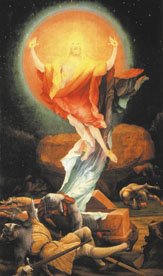
"And I will pour out on the house of David and the inhabitants of Jerusalem a spirit of compassion and supplication, so that, when they look on him whom they have pierced, they shall mourn for him, as one mourns for an only child, and weep bitterly over him, as one weeps over a first-born." (Zech. 12:10)
"And again another scripture says, "They shall look on him whom they have pierced."(Jn. 19:37)
"Behold, he is coming with the clouds, and every eye will see him, every one who pierced him; and all tribes of the earth will wail on account of him. Even so. Amen. " (Rev. 1:7)
Dr. Miravalle's Response To 7 Common Objections To Mary As Co-Redemptrix: Objection 4
Objection 4: To call Mary a co-redemptrix or to call Christians in general "co-redeemers" is to have a human being actively participate in redemption, which is a divine or, more specifically, a "theandric" activity, accomplished by Jesus Christ in his divine and human natures alone, and thus forbidden by Christianity. Such would only encourage paganism, since it places a human person, Mary, as part of a divine redemptive action which only Jesus Christ can accomplish.
Response:
In many ways, the response to this objection can be found in the same foundational evidence from Christian Scripture that responds to the previous objection to any subordinate or human participation in the one mediation of Jesus Christ (a mediation which includes redemption). But let us example the specific objection regarding Mary's active participation in the divine act of Redemption.
The full objection to Mary's active participation as Co-redemptrix in the redemption accomplished by Jesus Christ has been set out as follows. Theandric activity refers to an action by Jesus Christ that is accomplished through both of his natures, divine and human. Since the act of redemption by Jesus Christ was a theandric activity, and Mary was merely human, her actions were not theandric and therefore she cannot actively participate in redemption. Hence, Mary cannot be properly called a "co-redemptrix," a term which means she "bought back" humanity with the Redeemer. Nor should any Christians be called "co-redeemers" since no creature can participate in theandric activity.
To best address this objection, we must return to the essential etymological meaning of the term, "co-redemptrix." The Latin prefix, cum, means "with," and not "equal to." The Latin verb, re(d)-emere means, "to buy back," and the suffix -trix, meaning "one who does something," is feminine. In its complete form then, the term co-redemptrix refers to the "woman with the redeemer," or more literally, "the woman who buys back with (the Redeemer)."
As used by the Catholic Church, the term co-redemptrix expresses Mary's active and unique participation in the divine and human activity of redemption accomplished by Jesus Christ. Again, radically dependent and subordinate to the theandric redemptive action of Jesus Christ, the very perfection of this divine and human redemption provides for, rather than prohibits, various levels of true and active human participation.
While it is legitimate to distinguish theandric actions from human actions, it runs contrary to Christian Scripture and Christian Tradition, both ancient and developed, to reject active human participation in the theandric activity of Jesus Christ.
To actively participate in a theandric action does not require that the participator also have a divine and human nature. Such is to misunderstand the distinction between "being" in possessing the essence and specific attribute as part of who you are, from "participation" in sharing in the essence and specific attribute as possessed by another. Thus, Mary as a human creature can actively share in the theandric redemptive action of Jesus Christ without herself possessing the essence of divinity as a specific attribute. In a similar way, all Christians share in the divine nature of Jesus Christ (cf. 2 Pet 1:4), without being gods; participate in the sonship of Jesus Christ (cf. Gal 4:4) without being divinely begotten; share in the mediation of Christ (cf. Gal 3:19, 1 Tim 2:1) without being the one divine and human Mediator (1 Tim 2:5).
Once again, Christian Scripture attests to Mary's singular active participation in the Redemption of Jesus Christ. With Mary's free and active "fiat" to the invitation of the angel Gabriel to become the mother of Jesus, "Be it done unto me according to your word" (Lk. 1:38), she uniquely cooperated with the work of redemption by giving the divine Redeemer his body, which was the very instrument of human redemption. The prophecy of Simeon reveals the unparalleled co-redemptive mission of Mary in direct union with her Redeemer son in their one unified work of redemption, "and a sword shall pierce your own soul, too" (Lk. 2:34-5). And the climax of Mary's role as Co-redemptrix with and under her divine Son takes place at the foot of the Cross, where the total suffering of the mother's heart is obediently united to the suffering of the Son's heart in fulfillment of God the Father's plan of redemption: "Woman, behold your son!' Then he said to the disciple, 'behold, your mother!" (Jn. 19:27).
The earliest Christian writers and Fathers of the Church explained Marian participation with and under Christ in "buying back" the human family from the slavery of Satan and sin in the first theological model of Mary as the "New Eve." These ancient writers attested to the unity of Redemption by Christ and co-redemption by Mary by articulating that as Eve, the first "mother of the living"(Gen. 3:20) was an instrumental cause with Adam, the father of the human race in the loss of grace for all humanity, so too Mary, the "New Eve" was an instrumental cause with Jesus Christ, the "New Adam" (cf. 1 Cor. 15: 45-48, 20-25), in the restoration of grace to all humanity.
In the words of St. Irenaeus: "Just as Eve, wife of Adam, yet still a virgin, became by her disobedience the cause of death for herself and the whole human race, so Mary, too, espoused yet a virgin, Mary... became by her obedience the cause of salvation for herself and the whole human race."
Explicit teachings of Mary's active participation with Jesus Christ in redeeming or "buying back" humanity from the slavery of Satan and sin are present throughout early and later Christian Tradition, for example:
Through Mary, we "are redeemed from the tyranny of the devil." (Modestus of Jerusalem, 7th century);
Hail thou, through whom we are redeemed from the curse (St John Damascene, 8th century)";
Through her, man was redeemed (St. Bernard of Clairvaux, 12th century);
That woman (namely Eve), drove us out of Paradise and sold us; but this one (Mary) brought us back again and bought us;
Just as they (Adam and Eve) were the destroyers of the human race, so these (Jesus Christ and Mary) were its repairers;
She (Mary) also merited reconciliation for the entire human race;
She paid the price (of redemption) as a woman brave and loving—namely when Christ suffered on the cross to pay that price in order to purge and wash and redeem us, the Blessed Virgin was present, accepting and agreeing with the divine will (St. Bonaventure, 13th century);
To her alone was given this privilege, namely a communication in the Passion...and in order to make her a sharer in the benefit of Redemption, He willed that she be a sharer in the penalty of the Passion, in so far as she might become the mother of all through re-creation...(St. Albert the Great (or Pseudo-Albert), 13th century);
God accepted her oblation as a pleasing sacrifice for the utility and salvation of the whole human race...He foretold to thee (Mary) all thy passion whereby he would make thee a sharer of all of his merits and afflictions, and thou would co-operate with him in the restoration of men to salvation (John Tauler, 14th century);
...as one suffering with the Redeemer, for the captive sinner, Co-redemptrix would you be (14th century).
The Christian teaching on Co-redemptrix continues consistently from the middle ages on into the modern period, as evidenced in this representative selection of examples:
Saints and doctors have united in calling our Blessed Lady co-redemptrix of the world. There is no question of the lawfulness of using such language, because there is overwhelming authority for it... (Faber, 19th century);
We think of all the other extraordinary merits, by which she shared with her Son Jesus in the redemption of mankind....She was not only present at the mysteries of the Redemption, but was also involved with them (Pope Leo XIII, 19th century);
To such extent did she suffer and almost die with her suffering and dying Son; to such extent did she surrender her maternal rights over her Son for man's salvation, and immolated Him—insofar as she could—in order to appease the justice of God, that we may rightly say she redeemed the human race together with Christ (Pope Benedict XV, 20th century);
From the nature of his work the Redeemer ought to have associated his Mother with his work. For this reason, we invoke her under the title of Co-redemptrix (Pope Pius XI, 20th century);
Thus the Blessed Virgin advanced in her pilgrimage of faith, and faithfully persevered in union with her Son unto the cross, where she stood, in keeping with the divine plan, enduring with her only begotten Son the intensity of his suffering, associated herself with his sacrifice in her mother's heart, and lovingly consenting to the immolation of this victim which was born of her" (Second Vatican Council);
Crucified spiritually with her crucified Son (cf. Gal. 2:20), she contemplated with heroic love the death of her God....her role as Co-redemptrix did not cease with the glorification of her Son (Pope John Paul II, 1985);
The collaboration of Christians in salvation takes place after the Calvary event, whose fruits they endeavor to spread through prayer and sacrifice. Mary instead co-operated during the event itself and in the role as mother; thus her co-operation embraces the whole of Christ's saving work. She alone was associated in this way with the redemptive sacrifice that merited the salvation of mankind (Pope John Paul II, 1997).
The teaching of Christian Tradition upon Mary's unique co-redemptive role continues into the third millennium with this recent papal teaching of John Paul II, where Mary's intimate participation in the death of her Son at Calvary is compared with the Old Testament sacrificial offering made by Abraham (likewise of his own son, offered in an obedience of faith to God):
The summit of this earthly pilgrimage of faith is Golgotha where Mary intimately lives the paschal mystery of her Son: moved in a certain sense as a mother in the death of her Son, and opens herself to the "resurrection" with a new maternity in relation to the Church (cf. Jn. 19:25-27). There, on Calvary, Mary experiences the night of faith, similar to that of Abraham on Mount Moriah ....
Again, without question of the total and radical dependency of Mary's participation in redemption upon the divine work and merits of Jesus Christ, Church fathers and doctors, along with later and contemporary Christian Tradition, do not hesitate to teach the active participation of the woman, Mary with Jesus Christ in the theandric "buying back" or redeeming of humanity from the slavery of Satan and sin. This Marian sharing in redemption reflects the ancient Christian teaching that as humanity was lost or "sold" by a man and a woman, so it was God's will that humanity would be redeemed or "bought back" by a Man and a woman.
In what way then does Mary's participation as Co-redemptrix in human differ from the general call of Christians to participate in the redemption of Jesus Christ?
Indeed Christian Scripture calls all Christians to "make up what is lacking in the sufferings of Christ for the sake of his body, which is the Church" (Col. 1:24). This teaching of St. Paul is not speaking of a participation of all Christians in the historical and universal redemption on Calvary where Jesus Christ acquired the graces of Redemption by his passion and death (sometimes theologically referred to as objective redemption. If so, this would incorrectly infer that something was "lacking" in the historic redemptive sufferings and concurring saving merits of Jesus Christ, which were in itself infinite and inexhaustible.
Rather, St. Paul's teaching refers to the Christian imperative through free co-operation, prayer, and sacrifice to participate in the release and distribution of the infinite graces acquired by Jesus Christ on Calvary to the human family (theologically referred to as subjective redemption. Just as every human heart must actively respond in freedom to the saving grace of Jesus Christ for their own personal, subjective redemption, so too the Christian is called to actively participate in the release and distribution of the graces of redemption for others as well, and, in this way, to "make up" what St. Paul calls "lacking" in the sufferings of Christ for the sake of Christ's body. In this regard, all Christians truly participate in subjective redemption, this saving distribution of grace as "God's co-workers" (1Cor. 3:9) or "co-redeemers" to use the expression of 20th century popes.
Mary's redemptive participation differs from this general Christian call to participate in the distribution of saving graces in individual and personal subjective redemption in so far as she alone also participated, once again subordinately and entirely dependent upon the Redeemer, in the objective, historical and universal redemption as well, as the New Eve with and under the New Adam. This is why the title Co-redemptrix in the first place refers exclusively to Mary. As once again articulated by John Paul II in an 1997 Address:
The collaboration of Christians in salvation takes place after the Calvary event, whose fruits they endeavor to spread through prayer and sacrifice. Mary instead co-operated during the event itself and in the role as mother; thus her co-operation embraces the whole of Christ's saving work. She alone was associated in this way with the redemptive sacrifice that merited the salvation of mankind.
Therefore, the title and truth of Mary Co-redemptrix as seen in Christian Scripture and Christian Tradition underscores the legitimacy and spiritual fruitfulness for active human participation in the theandric redemptive action of Jesus Christ. For Mary Co-redemptrix, this participation in redemption constitutes a participation in both acquisition and distribution of redemptive graces; and for all other Christians a participation in the distribution of redemptive graces as co-redeemers in Christ. As summarized by Vatican theologian Jean Galot in the official Vatican publication, L'Osservatore Romano:
The title (Co-redemptrix) is criticized because it would suggest an equality between Mary and Christ. The criticism has no foundation...Co-redemption implies a subordination to the redemptive work of Christ, because it is only a cooperation and not an independent or parallel work. Hence any equality with Christ is excluded...The word "co-redemption," which means "cooperation in redemption," can be applied to every Christian and to the whole Church. St. Paul writes: 'We are God's co-workers' (1 Cor. 3:9).
Response:
In many ways, the response to this objection can be found in the same foundational evidence from Christian Scripture that responds to the previous objection to any subordinate or human participation in the one mediation of Jesus Christ (a mediation which includes redemption). But let us example the specific objection regarding Mary's active participation in the divine act of Redemption.
The full objection to Mary's active participation as Co-redemptrix in the redemption accomplished by Jesus Christ has been set out as follows. Theandric activity refers to an action by Jesus Christ that is accomplished through both of his natures, divine and human. Since the act of redemption by Jesus Christ was a theandric activity, and Mary was merely human, her actions were not theandric and therefore she cannot actively participate in redemption. Hence, Mary cannot be properly called a "co-redemptrix," a term which means she "bought back" humanity with the Redeemer. Nor should any Christians be called "co-redeemers" since no creature can participate in theandric activity.
To best address this objection, we must return to the essential etymological meaning of the term, "co-redemptrix." The Latin prefix, cum, means "with," and not "equal to." The Latin verb, re(d)-emere means, "to buy back," and the suffix -trix, meaning "one who does something," is feminine. In its complete form then, the term co-redemptrix refers to the "woman with the redeemer," or more literally, "the woman who buys back with (the Redeemer)."
As used by the Catholic Church, the term co-redemptrix expresses Mary's active and unique participation in the divine and human activity of redemption accomplished by Jesus Christ. Again, radically dependent and subordinate to the theandric redemptive action of Jesus Christ, the very perfection of this divine and human redemption provides for, rather than prohibits, various levels of true and active human participation.
While it is legitimate to distinguish theandric actions from human actions, it runs contrary to Christian Scripture and Christian Tradition, both ancient and developed, to reject active human participation in the theandric activity of Jesus Christ.
To actively participate in a theandric action does not require that the participator also have a divine and human nature. Such is to misunderstand the distinction between "being" in possessing the essence and specific attribute as part of who you are, from "participation" in sharing in the essence and specific attribute as possessed by another. Thus, Mary as a human creature can actively share in the theandric redemptive action of Jesus Christ without herself possessing the essence of divinity as a specific attribute. In a similar way, all Christians share in the divine nature of Jesus Christ (cf. 2 Pet 1:4), without being gods; participate in the sonship of Jesus Christ (cf. Gal 4:4) without being divinely begotten; share in the mediation of Christ (cf. Gal 3:19, 1 Tim 2:1) without being the one divine and human Mediator (1 Tim 2:5).
Once again, Christian Scripture attests to Mary's singular active participation in the Redemption of Jesus Christ. With Mary's free and active "fiat" to the invitation of the angel Gabriel to become the mother of Jesus, "Be it done unto me according to your word" (Lk. 1:38), she uniquely cooperated with the work of redemption by giving the divine Redeemer his body, which was the very instrument of human redemption. The prophecy of Simeon reveals the unparalleled co-redemptive mission of Mary in direct union with her Redeemer son in their one unified work of redemption, "and a sword shall pierce your own soul, too" (Lk. 2:34-5). And the climax of Mary's role as Co-redemptrix with and under her divine Son takes place at the foot of the Cross, where the total suffering of the mother's heart is obediently united to the suffering of the Son's heart in fulfillment of God the Father's plan of redemption: "Woman, behold your son!' Then he said to the disciple, 'behold, your mother!" (Jn. 19:27).
The earliest Christian writers and Fathers of the Church explained Marian participation with and under Christ in "buying back" the human family from the slavery of Satan and sin in the first theological model of Mary as the "New Eve." These ancient writers attested to the unity of Redemption by Christ and co-redemption by Mary by articulating that as Eve, the first "mother of the living"(Gen. 3:20) was an instrumental cause with Adam, the father of the human race in the loss of grace for all humanity, so too Mary, the "New Eve" was an instrumental cause with Jesus Christ, the "New Adam" (cf. 1 Cor. 15: 45-48, 20-25), in the restoration of grace to all humanity.
In the words of St. Irenaeus: "Just as Eve, wife of Adam, yet still a virgin, became by her disobedience the cause of death for herself and the whole human race, so Mary, too, espoused yet a virgin, Mary... became by her obedience the cause of salvation for herself and the whole human race."
Explicit teachings of Mary's active participation with Jesus Christ in redeeming or "buying back" humanity from the slavery of Satan and sin are present throughout early and later Christian Tradition, for example:
Through Mary, we "are redeemed from the tyranny of the devil." (Modestus of Jerusalem, 7th century);
Hail thou, through whom we are redeemed from the curse (St John Damascene, 8th century)";
Through her, man was redeemed (St. Bernard of Clairvaux, 12th century);
That woman (namely Eve), drove us out of Paradise and sold us; but this one (Mary) brought us back again and bought us;
Just as they (Adam and Eve) were the destroyers of the human race, so these (Jesus Christ and Mary) were its repairers;
She (Mary) also merited reconciliation for the entire human race;
She paid the price (of redemption) as a woman brave and loving—namely when Christ suffered on the cross to pay that price in order to purge and wash and redeem us, the Blessed Virgin was present, accepting and agreeing with the divine will (St. Bonaventure, 13th century);
To her alone was given this privilege, namely a communication in the Passion...and in order to make her a sharer in the benefit of Redemption, He willed that she be a sharer in the penalty of the Passion, in so far as she might become the mother of all through re-creation...(St. Albert the Great (or Pseudo-Albert), 13th century);
God accepted her oblation as a pleasing sacrifice for the utility and salvation of the whole human race...He foretold to thee (Mary) all thy passion whereby he would make thee a sharer of all of his merits and afflictions, and thou would co-operate with him in the restoration of men to salvation (John Tauler, 14th century);
...as one suffering with the Redeemer, for the captive sinner, Co-redemptrix would you be (14th century).
The Christian teaching on Co-redemptrix continues consistently from the middle ages on into the modern period, as evidenced in this representative selection of examples:
Saints and doctors have united in calling our Blessed Lady co-redemptrix of the world. There is no question of the lawfulness of using such language, because there is overwhelming authority for it... (Faber, 19th century);
We think of all the other extraordinary merits, by which she shared with her Son Jesus in the redemption of mankind....She was not only present at the mysteries of the Redemption, but was also involved with them (Pope Leo XIII, 19th century);
To such extent did she suffer and almost die with her suffering and dying Son; to such extent did she surrender her maternal rights over her Son for man's salvation, and immolated Him—insofar as she could—in order to appease the justice of God, that we may rightly say she redeemed the human race together with Christ (Pope Benedict XV, 20th century);
From the nature of his work the Redeemer ought to have associated his Mother with his work. For this reason, we invoke her under the title of Co-redemptrix (Pope Pius XI, 20th century);
Thus the Blessed Virgin advanced in her pilgrimage of faith, and faithfully persevered in union with her Son unto the cross, where she stood, in keeping with the divine plan, enduring with her only begotten Son the intensity of his suffering, associated herself with his sacrifice in her mother's heart, and lovingly consenting to the immolation of this victim which was born of her" (Second Vatican Council);
Crucified spiritually with her crucified Son (cf. Gal. 2:20), she contemplated with heroic love the death of her God....her role as Co-redemptrix did not cease with the glorification of her Son (Pope John Paul II, 1985);
The collaboration of Christians in salvation takes place after the Calvary event, whose fruits they endeavor to spread through prayer and sacrifice. Mary instead co-operated during the event itself and in the role as mother; thus her co-operation embraces the whole of Christ's saving work. She alone was associated in this way with the redemptive sacrifice that merited the salvation of mankind (Pope John Paul II, 1997).
The teaching of Christian Tradition upon Mary's unique co-redemptive role continues into the third millennium with this recent papal teaching of John Paul II, where Mary's intimate participation in the death of her Son at Calvary is compared with the Old Testament sacrificial offering made by Abraham (likewise of his own son, offered in an obedience of faith to God):
The summit of this earthly pilgrimage of faith is Golgotha where Mary intimately lives the paschal mystery of her Son: moved in a certain sense as a mother in the death of her Son, and opens herself to the "resurrection" with a new maternity in relation to the Church (cf. Jn. 19:25-27). There, on Calvary, Mary experiences the night of faith, similar to that of Abraham on Mount Moriah ....
Again, without question of the total and radical dependency of Mary's participation in redemption upon the divine work and merits of Jesus Christ, Church fathers and doctors, along with later and contemporary Christian Tradition, do not hesitate to teach the active participation of the woman, Mary with Jesus Christ in the theandric "buying back" or redeeming of humanity from the slavery of Satan and sin. This Marian sharing in redemption reflects the ancient Christian teaching that as humanity was lost or "sold" by a man and a woman, so it was God's will that humanity would be redeemed or "bought back" by a Man and a woman.
In what way then does Mary's participation as Co-redemptrix in human differ from the general call of Christians to participate in the redemption of Jesus Christ?
Indeed Christian Scripture calls all Christians to "make up what is lacking in the sufferings of Christ for the sake of his body, which is the Church" (Col. 1:24). This teaching of St. Paul is not speaking of a participation of all Christians in the historical and universal redemption on Calvary where Jesus Christ acquired the graces of Redemption by his passion and death (sometimes theologically referred to as objective redemption. If so, this would incorrectly infer that something was "lacking" in the historic redemptive sufferings and concurring saving merits of Jesus Christ, which were in itself infinite and inexhaustible.
Rather, St. Paul's teaching refers to the Christian imperative through free co-operation, prayer, and sacrifice to participate in the release and distribution of the infinite graces acquired by Jesus Christ on Calvary to the human family (theologically referred to as subjective redemption. Just as every human heart must actively respond in freedom to the saving grace of Jesus Christ for their own personal, subjective redemption, so too the Christian is called to actively participate in the release and distribution of the graces of redemption for others as well, and, in this way, to "make up" what St. Paul calls "lacking" in the sufferings of Christ for the sake of Christ's body. In this regard, all Christians truly participate in subjective redemption, this saving distribution of grace as "God's co-workers" (1Cor. 3:9) or "co-redeemers" to use the expression of 20th century popes.
Mary's redemptive participation differs from this general Christian call to participate in the distribution of saving graces in individual and personal subjective redemption in so far as she alone also participated, once again subordinately and entirely dependent upon the Redeemer, in the objective, historical and universal redemption as well, as the New Eve with and under the New Adam. This is why the title Co-redemptrix in the first place refers exclusively to Mary. As once again articulated by John Paul II in an 1997 Address:
The collaboration of Christians in salvation takes place after the Calvary event, whose fruits they endeavor to spread through prayer and sacrifice. Mary instead co-operated during the event itself and in the role as mother; thus her co-operation embraces the whole of Christ's saving work. She alone was associated in this way with the redemptive sacrifice that merited the salvation of mankind.
Therefore, the title and truth of Mary Co-redemptrix as seen in Christian Scripture and Christian Tradition underscores the legitimacy and spiritual fruitfulness for active human participation in the theandric redemptive action of Jesus Christ. For Mary Co-redemptrix, this participation in redemption constitutes a participation in both acquisition and distribution of redemptive graces; and for all other Christians a participation in the distribution of redemptive graces as co-redeemers in Christ. As summarized by Vatican theologian Jean Galot in the official Vatican publication, L'Osservatore Romano:
The title (Co-redemptrix) is criticized because it would suggest an equality between Mary and Christ. The criticism has no foundation...Co-redemption implies a subordination to the redemptive work of Christ, because it is only a cooperation and not an independent or parallel work. Hence any equality with Christ is excluded...The word "co-redemption," which means "cooperation in redemption," can be applied to every Christian and to the whole Church. St. Paul writes: 'We are God's co-workers' (1 Cor. 3:9).
Feast Of Guardian Angels
"How great the dignity of the soul, since each one has from his birth an angel commissioned to guard it. "
– St. Jerome
Today is the feast of guardian angels. I don't know about you, but my angel has had to work overtime many many times in my life. Let's take this day to say "thanks" to the angels who watch over us and keep us from all harm!
Prayer to Your Guardian Angel:
O Angel of Christ, holy guardian and protector of my soul and body, forgive me everything wherein I have offended thee every day of my life, and protect me from all influence and temptation of the evil one. May I nevermore anger God by any sins. Pray for me to the Lord, that He may make me worthy of the grace of the All-holy Trinity, and of the Most Blessed Theotokos, and of all the Saints. Amen.
Prayer To Holy Angels:
Bless the Lord, all you His angels. You who are mighty in strength and do His will, intercede for me at the throne of God. By your unceasing watchfulness protect me in every danger of soul and body. Obtain for me the grace of final perseverance, so that after this life I may be admitted to your glorious company and with you may sing the praises of God for all eternity.
All you holy angels and archangels, thrones and dominations, principalities and powers and virtues of heaven, cherubim and seraphim, and especially you, my dear guardian angel, intercede for me and obtain for me the special favor I now ask {mention your petition}.
Glory be to the Father, and to the Son, and to the Holy Spirit. As it was in the beginning, is now and ever shall be. Amen.
For some quotes on guardian angels from the Church Fathers, Check out this post by Mike Aquilina.
Sunday, October 01, 2006
Dr. Miravalle's Response To 7 Common Objections To Mary As Co-Redemptrix: Objection 3
Objection 3: Calling the Mother of Jesus, "Co-redemptrix" or her subsequent role as "Mediatrix" implies a role of mediation by someone other than Jesus Christ, but scripture plainly states in 1 Timothy 2:5 that "there is one God and one mediator between God and men, the man Christ Jesus," and therefore no creature can rightly be a mediator.
Response:
The definition of "mediator"—in Greek, mesitis, or "go-between"—is a person who intervenes between two other persons or parties for the goal of uniting or reconciling the parties. Applying this term to Jesus Christ, St. Paul indeed states that there is one mediator between the parties of God and humanity, namely the 'man Christ Jesus." No one therefore reaches God the Father except through the one, perfect mediation of Jesus Christ.
But the question still remains, does the one perfect mediation of Jesus Christ prevent or rather provide for others to subordinately participate in the one mediation of Jesus Christ? In other words, does the one exclusive mediation of Christ prevent any creature from participating in that one essential mediation? Or does its divine and human perfection allow others to share in his one mediation in a subordinate and secondary way?
Christian Scripture offers examples similar to this question of mediation where Christians are obliged to participate in something that is also "one," exclusive, and dependent entirely on the person of Jesus Christ.
The one Sonship of Jesus Christ. There is only one true Son of God, Jesus Christ, who was begotten from God the Father (1 Jn. 1-4). But all Christians are called to participate in the one true sonship of Jesus Christ by becoming "adopted sons" in Christ (cf. 2 Cor. 5:17; 1 Jn. 3:1; Gal. 2:20), as a true sharing in the one sonship of Christ through baptism which allows adopted sons and daughters to also share in the inheritance of the one Son, that of everlasting life.
Living in the One Christ. All Christians are called to share in the "one life" of Jesus Christ, for grace is to participate in the life and the love of Jesus Christ, and through him in the life and love of the Trinity. As St. Paul teaches, "it is not I, but Christ who lives in me" (Gal. 2:20) and 2 Peter 1:4 calls Christians to become "partakers of the divine nature," to live in the one Christ, and thus in the life of the Trinity.
The one Priesthood of Jesus Christ. All Christians are also called to share in different degrees in the one priesthood of Jesus Christ. The book of Hebrews identifies Jesus Christ as the one "high priest" (cf. Heb. 3:1; 4:14; 5:10) who offers the great spiritual sacrifice of himself on Calvary. And yet Scripture calls all Christians, albeit on different levels of participation, ministerial (cf. Acts 14:22) or royal (cf.1 Pet. 2:9), to participate in the one priesthood of Jesus Christ in offering "spiritual sacrifice." All Christians are instructed to "offer spiritual sacrifices acceptable to God" (1 Pet. 2:5, 2:9).
In all these cases, the New Testament calls Christians to share in that which is one and unique of Jesus Christ, the Alpha and Omega, in true though completely subordinate levels of participation. In reference, then, to Christ the one Mediator (1 Tim 2:5), we see the same Christian imperative for others to share or participate in the one mediation of Jesus Christ, but in a secondary mediation entirely dependent upon the one perfect mediation of Jesus Christ.
The pivotal christological question must then be asked: Does such subordinate sharing in the one mediation of Christ obscure the one mediation of Christ, or rather does it manifest the glory of his one mediation? This is easily answered by imagining a contemporary world without "adopted sons and daughters in Christ," without Christians today sharing in the one life of Jesus Christ in grace, or without any Christians offering spiritual sacrifices in the Christian priesthood. Such an absence of human participation would only result in obscuring the one Sonship, the one High Priesthood, and the very Life of grace in Jesus Christ.
The same principle is true regarding participation in the one mediation of Jesus Christ in a dependent and subordinate way: the more human participation in the one mediation of Christ, the more the perfection, power, and glory of the unique and necessary mediation of Jesus Christ is manifested to the world.
Christian Scripture moreover offers several examples of God-instituted human mediators who cooperated by divine initiative in uniting humanity with God. The great prophets of the Old Testament were God-ordained mediators between Yahweh and the people of Israel, oftentimes seeking to return the people of Israel to their fidelity to Yahweh (cf. Is. 1; Jer. 1: Ez. 2). The Old Testament patriarchs, Abraham, Isaac, Jacob, and Moses, etc., were at God's initiative the human mediators of the saving covenant between Yahweh and the people of Israel (cf. Gen 12:2; 15:18; Ex. 17:11). St. Paul identifies Moses' mediation of the law to the Israelites: " Why then the law? It was ordained by God through an intermediary" (Gal 3:19-20). And the angels, with hundreds of mediating acts spanning Old and New Testaments, are God's messengers, who mediate for reconciliation between God and the human family, both before and after the coming of Christ, the one Mediator (cf. Gen. 3:24; Lk. 1:26; Lk. 1:19).
Now regarding Mary, Christian Scripture also clearly reveals the secondary and subordinate participation of the Mother of Jesus in the one mediation of Jesus Christ. At the Annunciation, Mary's free and active "yes" to the invitation of the angel mediates to the world Jesus Christ, the Redeemer of the world and the Author of all graces (cf. Lk. 1:38). For this unique participation in giving to the Redeemer his body and mediating the Source of all graces to the world, Mary can rightly be called both "Co-redemptrix" and "Mediatrix of all graces" as one who uniquely shares in the one mediation of Jesus Christ.
This unique Marian participation in Christ's mediation, specific to the Redemption of Jesus Christ, is climaxed at Calvary. At the cross, her spiritual suffering united to the redemptive sacrifice of her Son, as the New Eve with the New Adam, leads to the universal spiritual fruits of the acquisition of the graces of redemption, which, in turn, leads to the gift of spiritual motherhood from the heart of the Crucified Christ to every human heart: "Behold your mother" (Jn. 19:27). The Redeemer's gift of his own mother as spiritual mother to all humanity leads to the spiritual nourishment by the Mother to her children in the order of grace. This constitutes the distribution of the graces of Calvary by Mary to her spiritual children as Mediatrix of all graces, which perpetually continues her unique sharing in the one saving mediation of Jesus Christ.
John Paul II explains the Catholic understanding of this unique Marian participation in the one mediation of Jesus Christ:
Mary entered, in a way all her own, into the one mediation "between God and men" which is the mediation of the man Christ Jesus.... We must say that through this fullness of grace and supernatural life, she was especially pre-disposed to cooperation with Christ, the one Mediator of human salvation. And such cooperation is precisely this mediation subordinated to the mediation of Christ.
In Mary's case, we have a special and exceptional mediation.
And in his commentary on 1 Timothy 2:5 and Mary's maternal mediation, John Paul II further states:
We recall that Mary's mediation is essentially defined by her divine motherhood. Recognition of her role as mediatrix is moreover implicit in the expression "our Mother," which presents the doctrine of Marian mediation by putting the accent on her motherhood...In proclaiming Christ the one mediator (cf. 1 Tim 2:5-6), the text of St. Paul's Letter to Timothy excludes any other parallel mediation, but not subordinate mediation. In fact, before emphasizing the one exclusive mediation of Christ, the author urges "that supplications, prayers, intercessions and thanksgivings be made for all men" (2:1). Are not prayers a form of mediation? Indeed, according to St. Paul, the unique mediation of Christ is meant to encourage other dependent, ministerial forms of mediation...In truth, what is Mary's maternal mediation if not the Father's gift to humanity?
Therefore we can see Mary's participation in the one mediation of Jesus Christ as unique and unparalleled by any other human or angelic participation, and yet entirely subordinate and dependent upon the one mediation of Jesus Christ. As such, Mary's motherly mediation manifests the true glory and power of Christ's mediation like no other. The Marian titles and roles of Co-redemptrix and Mediatrix of all graces (and Advocate as well) do not in any way violate the prohibition of 1 Tim. 2:5 against any parallel, autonomous, or rival mediation, but bespeak a unique and exceptional motherly participation in that one, perfect, and saving mediation of Jesus Christ.
In the words of Anglican Oxford scholar, Dr. John Macquarrie:
The matter (of Marian mediation) cannot be settled by pointing to the danger of exaggeration and abuse, or by appealing to isolated texts of scripture as the verse quoted above from 1 Timothy 2...or by the desire not to say anything that might offend one's partners in ecumenical dialogue. Unthinking enthusiasts may have elevated Mary's position to a virtual equality with Christ, but this aberration is not a necessary consequence of recognizing that there may be a truth striving for expression in words like Mediatrix and Co-redemptrix.
All responsible theologians would agree that Mary's co-redemptive role is subordinate and auxiliary to the central role of Christ. But if she does have such a role, the more clearly we understand it, the better. And like other doctrines concerning Mary, it is not only saying something about her, but something more general about the Church as a whole, and even humanity as a whole.
Response:
The definition of "mediator"—in Greek, mesitis, or "go-between"—is a person who intervenes between two other persons or parties for the goal of uniting or reconciling the parties. Applying this term to Jesus Christ, St. Paul indeed states that there is one mediator between the parties of God and humanity, namely the 'man Christ Jesus." No one therefore reaches God the Father except through the one, perfect mediation of Jesus Christ.
But the question still remains, does the one perfect mediation of Jesus Christ prevent or rather provide for others to subordinately participate in the one mediation of Jesus Christ? In other words, does the one exclusive mediation of Christ prevent any creature from participating in that one essential mediation? Or does its divine and human perfection allow others to share in his one mediation in a subordinate and secondary way?
Christian Scripture offers examples similar to this question of mediation where Christians are obliged to participate in something that is also "one," exclusive, and dependent entirely on the person of Jesus Christ.
The one Sonship of Jesus Christ. There is only one true Son of God, Jesus Christ, who was begotten from God the Father (1 Jn. 1-4). But all Christians are called to participate in the one true sonship of Jesus Christ by becoming "adopted sons" in Christ (cf. 2 Cor. 5:17; 1 Jn. 3:1; Gal. 2:20), as a true sharing in the one sonship of Christ through baptism which allows adopted sons and daughters to also share in the inheritance of the one Son, that of everlasting life.
Living in the One Christ. All Christians are called to share in the "one life" of Jesus Christ, for grace is to participate in the life and the love of Jesus Christ, and through him in the life and love of the Trinity. As St. Paul teaches, "it is not I, but Christ who lives in me" (Gal. 2:20) and 2 Peter 1:4 calls Christians to become "partakers of the divine nature," to live in the one Christ, and thus in the life of the Trinity.
The one Priesthood of Jesus Christ. All Christians are also called to share in different degrees in the one priesthood of Jesus Christ. The book of Hebrews identifies Jesus Christ as the one "high priest" (cf. Heb. 3:1; 4:14; 5:10) who offers the great spiritual sacrifice of himself on Calvary. And yet Scripture calls all Christians, albeit on different levels of participation, ministerial (cf. Acts 14:22) or royal (cf.1 Pet. 2:9), to participate in the one priesthood of Jesus Christ in offering "spiritual sacrifice." All Christians are instructed to "offer spiritual sacrifices acceptable to God" (1 Pet. 2:5, 2:9).
In all these cases, the New Testament calls Christians to share in that which is one and unique of Jesus Christ, the Alpha and Omega, in true though completely subordinate levels of participation. In reference, then, to Christ the one Mediator (1 Tim 2:5), we see the same Christian imperative for others to share or participate in the one mediation of Jesus Christ, but in a secondary mediation entirely dependent upon the one perfect mediation of Jesus Christ.
The pivotal christological question must then be asked: Does such subordinate sharing in the one mediation of Christ obscure the one mediation of Christ, or rather does it manifest the glory of his one mediation? This is easily answered by imagining a contemporary world without "adopted sons and daughters in Christ," without Christians today sharing in the one life of Jesus Christ in grace, or without any Christians offering spiritual sacrifices in the Christian priesthood. Such an absence of human participation would only result in obscuring the one Sonship, the one High Priesthood, and the very Life of grace in Jesus Christ.
The same principle is true regarding participation in the one mediation of Jesus Christ in a dependent and subordinate way: the more human participation in the one mediation of Christ, the more the perfection, power, and glory of the unique and necessary mediation of Jesus Christ is manifested to the world.
Christian Scripture moreover offers several examples of God-instituted human mediators who cooperated by divine initiative in uniting humanity with God. The great prophets of the Old Testament were God-ordained mediators between Yahweh and the people of Israel, oftentimes seeking to return the people of Israel to their fidelity to Yahweh (cf. Is. 1; Jer. 1: Ez. 2). The Old Testament patriarchs, Abraham, Isaac, Jacob, and Moses, etc., were at God's initiative the human mediators of the saving covenant between Yahweh and the people of Israel (cf. Gen 12:2; 15:18; Ex. 17:11). St. Paul identifies Moses' mediation of the law to the Israelites: " Why then the law? It was ordained by God through an intermediary" (Gal 3:19-20). And the angels, with hundreds of mediating acts spanning Old and New Testaments, are God's messengers, who mediate for reconciliation between God and the human family, both before and after the coming of Christ, the one Mediator (cf. Gen. 3:24; Lk. 1:26; Lk. 1:19).
Now regarding Mary, Christian Scripture also clearly reveals the secondary and subordinate participation of the Mother of Jesus in the one mediation of Jesus Christ. At the Annunciation, Mary's free and active "yes" to the invitation of the angel mediates to the world Jesus Christ, the Redeemer of the world and the Author of all graces (cf. Lk. 1:38). For this unique participation in giving to the Redeemer his body and mediating the Source of all graces to the world, Mary can rightly be called both "Co-redemptrix" and "Mediatrix of all graces" as one who uniquely shares in the one mediation of Jesus Christ.
This unique Marian participation in Christ's mediation, specific to the Redemption of Jesus Christ, is climaxed at Calvary. At the cross, her spiritual suffering united to the redemptive sacrifice of her Son, as the New Eve with the New Adam, leads to the universal spiritual fruits of the acquisition of the graces of redemption, which, in turn, leads to the gift of spiritual motherhood from the heart of the Crucified Christ to every human heart: "Behold your mother" (Jn. 19:27). The Redeemer's gift of his own mother as spiritual mother to all humanity leads to the spiritual nourishment by the Mother to her children in the order of grace. This constitutes the distribution of the graces of Calvary by Mary to her spiritual children as Mediatrix of all graces, which perpetually continues her unique sharing in the one saving mediation of Jesus Christ.
John Paul II explains the Catholic understanding of this unique Marian participation in the one mediation of Jesus Christ:
Mary entered, in a way all her own, into the one mediation "between God and men" which is the mediation of the man Christ Jesus.... We must say that through this fullness of grace and supernatural life, she was especially pre-disposed to cooperation with Christ, the one Mediator of human salvation. And such cooperation is precisely this mediation subordinated to the mediation of Christ.
In Mary's case, we have a special and exceptional mediation.
And in his commentary on 1 Timothy 2:5 and Mary's maternal mediation, John Paul II further states:
We recall that Mary's mediation is essentially defined by her divine motherhood. Recognition of her role as mediatrix is moreover implicit in the expression "our Mother," which presents the doctrine of Marian mediation by putting the accent on her motherhood...In proclaiming Christ the one mediator (cf. 1 Tim 2:5-6), the text of St. Paul's Letter to Timothy excludes any other parallel mediation, but not subordinate mediation. In fact, before emphasizing the one exclusive mediation of Christ, the author urges "that supplications, prayers, intercessions and thanksgivings be made for all men" (2:1). Are not prayers a form of mediation? Indeed, according to St. Paul, the unique mediation of Christ is meant to encourage other dependent, ministerial forms of mediation...In truth, what is Mary's maternal mediation if not the Father's gift to humanity?
Therefore we can see Mary's participation in the one mediation of Jesus Christ as unique and unparalleled by any other human or angelic participation, and yet entirely subordinate and dependent upon the one mediation of Jesus Christ. As such, Mary's motherly mediation manifests the true glory and power of Christ's mediation like no other. The Marian titles and roles of Co-redemptrix and Mediatrix of all graces (and Advocate as well) do not in any way violate the prohibition of 1 Tim. 2:5 against any parallel, autonomous, or rival mediation, but bespeak a unique and exceptional motherly participation in that one, perfect, and saving mediation of Jesus Christ.
In the words of Anglican Oxford scholar, Dr. John Macquarrie:
The matter (of Marian mediation) cannot be settled by pointing to the danger of exaggeration and abuse, or by appealing to isolated texts of scripture as the verse quoted above from 1 Timothy 2...or by the desire not to say anything that might offend one's partners in ecumenical dialogue. Unthinking enthusiasts may have elevated Mary's position to a virtual equality with Christ, but this aberration is not a necessary consequence of recognizing that there may be a truth striving for expression in words like Mediatrix and Co-redemptrix.
All responsible theologians would agree that Mary's co-redemptive role is subordinate and auxiliary to the central role of Christ. But if she does have such a role, the more clearly we understand it, the better. And like other doctrines concerning Mary, it is not only saying something about her, but something more general about the Church as a whole, and even humanity as a whole.
The Little Flower

Today is the feast day of St. Therese of Lisieux in the new calendar of the Church. Her old feast day is on Oct. 3, the day of her burial. Today also starts the Triduum of St. Therese. If you live in Pittsburgh, there will be a mass on Monday and Tuesday night at 7pm to celebrate the Triduum at St. Boniface Church.
"Since my longing for martyrdom was powerful and unsettling, I turned to the epistles of Saint Paul in the hope of finally finding an answer. By chance the twelfth and thirteenth chapters of the first epistle to the Corinthians caught my attention, and in the first section I read that not everyone can be an apostle, prophet or teacher, that the Church is composed of a variety of members, and that the eye cannot be the hand. Even with such an answer revealed before me, I was not satisfied and did not find peace.
I persevered in the reading and did not let my mind wander until I found this encouraging theme: "Set your desires on the greater gifts. And I will not show you the way which surpasses all others." For the Apostle insists that the greater gifts are nothing at all without love and that this same love is surely the best path leading directly to God. At length I had found peace of mind.
Love appeared to me to be the hinge for my vocation. Indeed, I knew that the Church had a body composed of various members, but in this body the necessary and more noble member was not lacking; I knew that the Church had a heart and that such a heart appeared to be aflame with love. I knew that one love drove the members of the Church to action, that if this love were extinguished, the apostles would have proclaimed the Gospel no longer, the martyrs would have shed their blood no more. I saw and realized that love sets off the bounds of all vocations, that love is everything, that this same love embraces every time and every place. In one word, that love is everlasting."
-from the autobiography of Saint Therese of the Child Jesus
Subscribe to:
Posts (Atom)